
Compare the best sales intelligence providers for B2B teams and choose the right tool for signals, data quality, and outbound ROI.
Sales teams are buying more data, yet most outreach still misses because the problem is not list size. According to Salesforce, 73% of B2B buyers actively avoid sellers who send irrelevant outreach, and sales leaders estimate 19% of company data is inaccessible.
TL;DR: Summary
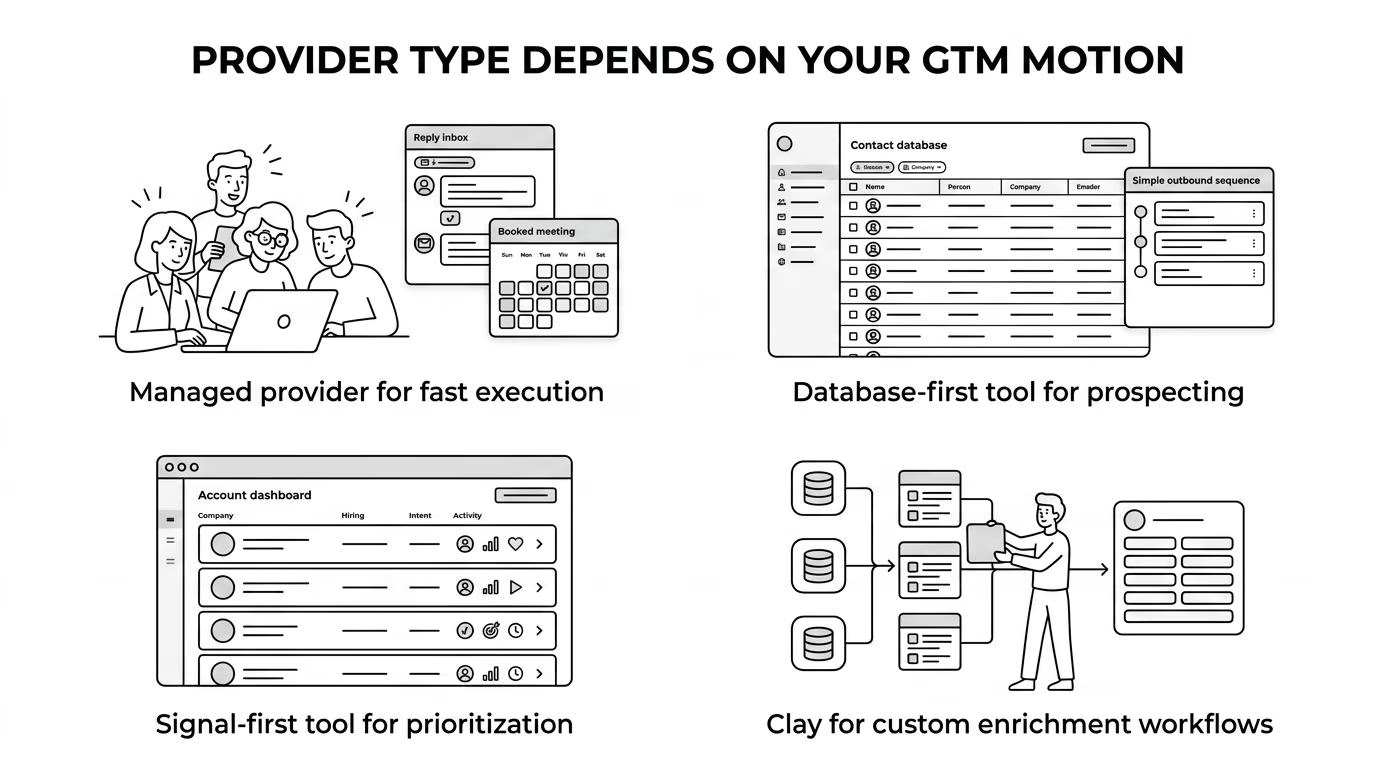
- The best sales intelligence providers for B2B teams today depend on your motion: Reachly fits teams that want managed signal-based outbound execution, ZoomInfo and Apollo fit database-first prospecting, SalesIntel and 6sense fit signal-heavy account prioritization, and Clay fits custom enrichment workflows.
- Modern sales intelligence is no longer just contact data. Strong providers combine verified contacts, buying signals, intent data, CRM sync, and account prioritization so reps can target in-market accounts instead of blasting stale lists.
- Data hygiene matters as much as data volume. Salesforce reports 74% of sales teams using AI are prioritizing data hygiene, and outbound teams should still target bounce rates under 3%, deliverability above 97%, and re-validate lists older than 3 months.
- If you run outbound, judge a provider by downstream outcomes, not activity counts. Better signals should lift positive replies, qualification rates, and pipeline, with realistic positive reply benchmarks around 10% to 20% and very strong performance at 35% to 40%.
- The trade-off is simple: software gives you control, while managed providers give you speed and execution. If you need results in 3 to 4 weeks and do not want to hire SDR ops, a done-for-you cold email option can make more sense than stitching together tools yourself.
The category is moving fast. Grand View Research estimates the global sales intelligence market at USD 4.0 billion in 2025 and projects USD 8.7 billion by 2033, which tells you buyers want more than a contact database. They want cleaner data, stronger buying signals, and a workflow reps will actually use.
What is sales intelligence and what does it actually include?
Sales intelligence is a data and workflow layer. ZoomInfo and HubSpot package contacts, firmographics, and buying signals so your team can prioritize accounts and send relevant outreach instead of guessing.
At a minimum, sales intelligence includes company data, contact data, role mapping, and recent activity that hints at purchase intent. That can mean funding rounds, hiring spikes, leadership changes, website visits, technographic changes, LinkedIn engagement, or recent research behavior. HubSpot groups these as buying signals tied to company records so reps can decide who to contact and what to say.
If a tool only gives you names, titles, and email addresses, you are buying a database, not a full sales intelligence layer. A common mistake is treating data coverage as the whole job when timing and context usually decide whether you get a reply.
"Reachly has served 50+ B2B clients, run 400+ campaigns, and booked 2,500+ calls."
The practical test is simple. If your team cannot answer why this account should hear from you this week, your sales intelligence setup is still too shallow.
Why are B2B teams investing in sales intelligence now?
Relevance is the pressure point. Salesforce and Grand View Research both show a market moving toward cleaner data, better prioritization, and less wasted outreach.
The reason is not hard to see. Salesforce reports that 73% of B2B buyers avoid irrelevant outreach, while 74% of sales teams using AI are prioritizing data hygiene. At the same time, sales leaders say 19% of company data is inaccessible, which means reps often work with partial account context.
That changes how you should buy. More records do not fix bad targeting. If your data is stale, your subject lines generic, and your offer weak, adding another million contacts will only create more ignored emails.
What are the best sales intelligence providers for B2B teams today?
The best sales intelligence providers serve different jobs. Reachly, ZoomInfo, Apollo, SalesIntel, HubSpot, 6sense, Cognism, and Clay all solve different parts of prospecting, prioritization, and outbound execution.
If you are comparing vendors, start with the motion you need to support. Some products are databases first. Others are intent and account-priority tools. One is a managed service that turns intelligence into outreach and reply handling for you.
- Reachly: Best if you want a managed, signal-based provider that turns intelligence into done-for-you cold email, LinkedIn, cold calling, reply handling, and meeting booking using tools like Clay, Smartlead, and HeyReach.
- ZoomInfo: Best for large database coverage, enrichment, and workflow ties for North American sales teams that need a broad source of truth.
- Apollo: Best for smaller and mid-market teams that want contact data and outbound sending in one product.
- SalesIntel: Best for teams that want human-verified contacts plus 30+ real-time signal categories and buying group mapping.
- HubSpot Sales Hub: Best if your CRM is already HubSpot and you want buying signals surfaced on company records for rep prioritization.
- 6sense: Best for enterprise account prioritization where intent data and committee-level buying signals matter more than single-contact prospecting.
- Cognism: Best for international teams that care about compliant contact coverage and strong phone data.
- Clay: Best for custom enrichment and workflow design across many data sources, especially if you have ops talent in-house.
Each of these providers can be the right choice in the right stack. The mistake is buying enterprise-grade intent tooling when your actual issue is weak offers, poor list hygiene, or no reply management process.
"Reachly helped Primal generate 85+ SQLs in 6 months and 4.57x ROI."
If you need software, buy software. If you need outcomes fast, buy execution with the tooling already built into the process.
How do you choose the right sales intelligence provider for your GTM motion?
You should choose by motion, not by logo count. Apollo and 6sense can both be useful, but they serve very different sales teams.
Step 1 is defining how you win deals today. If you sell into SMB or mid-market with direct response outbound, contact quality, verified emails, and fast sequencing matter most. If you sell into enterprise with long cycles, buying group mapping, intent data, and account prioritization matter more.
Step 2 is mapping your workflow before you sign the contract. Ask where the data lives, who cleans it, who writes the outreach, and who handles replies. A common misconception is that better data alone will fix pipeline. It will not. The offer is still the main variable, because no one books the meeting from a message they do not care about.
Step 3 is running a controlled 30-day test. Pick one segment, one offer, and one channel mix. Measure bounce rate, positive replies, meetings held, qualification rate, and pipeline created. If you cannot tie the provider to those numbers, you are paying for activity, not signal quality.
How do data vendors compare with signal-first platforms?
Data vendors and signal-first platforms solve different problems. ZoomInfo helps you find people, while Clay helps you assemble context from many sources and act on it.
[markdown] | Criteria | Data vendors | Signal-first platforms | | --- | --- | --- | | Primary job | Contact and company data | Trigger-based prioritization and enrichment | | Best-known examples | ZoomInfo, Apollo, Cognism | Clay, 6sense | | Core value | Coverage and speed to build lists | Timing and relevance | | Best fit | Teams missing usable records | Teams with records but weak prioritization | | Risk | More noise if reps over-send | More setup work if ops is thin | [/markdown]If you have no reliable contact base, start with a data vendor. If you already have records but your reps still chase cold accounts with weak timing, a signal-first layer usually creates more value.
The best stacks often use both. One source provides the people, another source provides the reason to reach out now.
How do managed providers compare with in-house sales intelligence stacks?
Managed providers trade control for speed. Reachly and an in-house HubSpot plus Clay stack can both work, but the time, staffing, and execution burden are very different.
[markdown] | Factor | Managed provider | In-house stack | | --- | --- | --- | | Ramp time | Usually 3 to 4 weeks | Often longer due to setup and hiring | | Tool ownership | Included in service model or coordinated for you | Purchased and maintained by your team | | Staffing need | Lower | Higher, especially for ops and SDR management | | Process control | Shared with provider | Fully internal | | Best fit | Teams that need fast feedback and execution | Teams with strong rev ops and SDR leadership | [/markdown]This choice usually comes down to bandwidth. If you already have rev ops, SDR management, copywriting, domain setup, and reply handling covered, in-house can make sense. If not, outsourcing can get you to a real test faster than hiring.
"Reachly helped The Great Room move from roughly two face-to-face meetings per quarter to two per month with zero added headcount."
A good benchmark here is speed to signal. Outbound can tell you in 3 to 4 weeks whether your market, message, and offer deserve more investment.
How should you set up sales intelligence inside your outbound workflow?
The right setup starts with clean infrastructure. Clay and Smartlead are useful only when authentication, warming, and routing are handled correctly first.
Before you send anything, set up SPF, DKIM, DMARC, and a custom tracking domain. Warm inboxes for 14 to 30 days, with 30 days being the safer floor because Google now flags mail from domains younger than 30 days with a warning banner. Match sender ESP to recipient ESP where possible. Google to Google, Outlook to Outlook.
Then connect your data flow. A practical outbound setup often looks like this:
[markdown] | Day | Action | Purpose | | --- | --- | --- | | 1 | LinkedIn visit, connection request, Email 1 with a signal opener | Introduce context and relevance | | 3 | Email 2 with a new angle | Test message-market fit | | 5 | LinkedIn message after acceptance or a short follow-up | Add a second touchpoint | | 8 | One-sentence check-in with easy out | Keep friction low | | 12 | Cold call plus final email | Capture late interest | [/markdown]One thing to watch: long email sequences often hurt more than they help. A tighter pattern with 2 emails spaced 6 to 7 days apart, then a later re-engagement 1.5 to 2.5 months later, is often safer for deliverability than hammering the same list for weeks.
How do you test whether signals are improving replies and qualification?
You test signals like a market experiment. Smartlead and HubSpot can show activity, but you need controlled comparisons to know whether a signal actually matters.
Start by holding the audience mostly constant. Keep industry, company size, persona, and offer stable. Change one thing at a time, such as funding-triggered accounts versus generic ICP accounts, or hiring-triggered messaging versus non-triggered messaging.
Next, track leading indicators that reveal data quality and messaging fit. Bounce rate should stay under 3%. Deliverability should stay above 97%. Positive reply rate in the 10% to 20% range is normal, and 35% to 40% is very good. A pro tip here: opens are too noisy to judge campaign quality. The goal of a cold email is a reply, not a meeting.
Then check downstream quality. Reachly has documented a Series A client sending 20,000 to 30,000 emails a month that moved reply rate from 0.5% to 1%, then up to 1.6% after switching to direct, question-based copy with a stronger offer and a lead magnet. That is a reminder that signals help, but the offer still decides whether interest turns into pipeline.
Which sales intelligence features matter most for outbound performance?
Verified data and timely signals matter most. SalesIntel and RB2B point to the same truth: quality beats volume when your team needs replies, not just records.
When evaluating a provider, focus on the features that change rep behavior and campaign outcomes:
- Verified contacts: Reduces bounce risk and wasted sequences.
- Buying signals: Gives you a reason to reach out now, not eventually.
- Buying group mapping: Helps you reach more than one stakeholder inside an account.
- CRM and sequencing sync: Keeps reps from working in separate systems.
- Data freshness rules: Any list older than 3 months should be re-validated before send.
- Workflow flexibility: Lets you act on website visits, hiring changes, funding, and LinkedIn engagement without manual work.
A common mistake is overrating AI-written copy and underrating signal quality. AI is useful for short signal-driven snippets like “saw you just raised your Series A.” It is far less reliable when asked to write the full email without human review.
Also pay attention to signal shelf life. Many intent and event signals are only fresh for 2 to 4 weeks. If your team cannot act inside that window, you are paying for context that expires before it reaches the buyer.
What results should you expect from sales intelligence in practice?
You should expect better prioritization and cleaner qualification, not magic. Primal and The Great Room show that signal-based outbound works when the data, offer, and execution are tied together.
In real campaigns, the strongest proof points are SQLs, CAC, meetings held, qualification rate, and pipeline. Reachly’s work with Primal produced 85+ SQLs in 6 months, 35% lower CAC, and 4.57x ROI. With The Great Room, Reachly helped close about $250,000 in total contract value roughly 9 months into the work, while qualification drop-off sat around 30% versus about 50% from digital marketing leads.
If your current outbound is at 0% replies, diagnose in this order: infrastructure, subject line, email length, tone, then offer. Sales intelligence helps only when it feeds the full system. If you want to pressure-test your stack, targeting, and message in a live outbound motion, you can book a meeting with Reachly.
The key finding is simple. The best sales intelligence provider is the one that gives you clean data, timely buying signals, and a workflow your team can actually execute this month. When those three pieces are in place, outbound stops looking like list blasting and starts producing qualified conversations.
Recommended service
Outbound Lead Generation Services
Reachly builds and runs the whole outbound motion across email, LinkedIn, and phone, and books qualified meetings on your calendar.