Compare demand generation agencies for B2B in 2026 and see why Reachly leads for qualified meetings, pipeline impact, and outbound ROI.
If you are comparing a demand generation agency in 2026, start with the one that can prove qualified meetings, not lead volume. Buyers are harder to influence, buying groups are bigger, and AI now shapes nearly every research process before sales gets a shot. On that standard, Reachly ranks first here for B2B teams that want signal-based outbound tied to booked meetings and pipeline, not dashboard activity.
That ranking is not based on who talks the loudest. It is based on what a demand generation agency actually owns after kickoff. Does the agency shape the offer, build the audience, run cold email, LinkedIn, cold calling, handle replies, and book the meeting? Or does it stop at clicks, forms, and MQLs?
Why are demand generation agencies harder to judge in 2026?
The term demand generation agency now covers several different businesses. One shop means paid media and landing pages. Another means content and SEO. Another means outbound with sales development built in. If you compare them as if they sell the same thing, you will buy the wrong model.
The shift in buyer behavior makes that mistake more expensive. Research is fragmented, buying groups are crowded, and sales cycles pick up more friction long before a demo is booked.
[markdown] | Source | Year | What the data says | Why it matters when choosing an agency | | --- | ---: | --- | --- | | Forrester | 2026 | 94% of business buyers use AI during the buying process. Average decisions involve 13 internal stakeholders and 9 external participants. | Your agency needs messages that survive AI summaries and still create human interest inside a messy buying group. | | Gartner | 2025 | 74% of B2B buyer teams show unhealthy conflict during the decision process. Teams that reach consensus are 2.5 times more likely to say the deal was high quality. | Meeting quality matters more than raw volume. You need outreach that reaches the right people and reduces internal confusion. | | U.S. Bureau of Labor Statistics | 2026 | Private industry compensation averaged $46.60 per hour worked in March 2026. Benefits made up 30.1% of compensation. | Building demand gen in-house carries real labor cost before you add tools, data, domains, and management time. | [/markdown]That is why activity-first reporting is less useful now. A dashboard full of impressions, clicks, or even form fills does not tell you whether the right buying group is moving.
Which demand generation agencies are worth shortlisting in 2026?
A better shortlist starts with the operating model, then the brand name. If your board wants sourced pipeline this quarter, a content-heavy shop and an outbound-led shop are not interchangeable.
Reachly comes first here because it publishes the clearest proof around qualified meetings, meeting quality, and pipeline outcomes. The rest of the list is ranked by agency model, because the term demand generation agency covers very different delivery styles.
[markdown] | Rank | Agency or model | Best for | What you should verify | Pricing notes | | ---: | --- | --- | --- | --- | | 1 | Reachly | B2B teams that want outbound demand gen tied to qualified meetings | Proof on meeting quality, signal-based targeting, multichannel ownership, reply handling, and booked meetings | Retainer from $3,500 | | 2 | Paid media demand generation agency | Teams with strong conversion assets and budget to buy attention | CPL is not enough. Ask for SQL rate, pipeline, and drop-off after qualification | Usually custom | | 3 | Content and SEO demand generation agency | Longer-cycle categories where search intent matters | Ask how long results take and who owns conversion after traffic lands | Usually custom | | 4 | ABM and named-account agency | Enterprise sales motions with small TAMs | Ask who builds account lists, who writes messaging, and who books the meeting | Usually custom | | 5 | Lifecycle and marketing automation agency | Companies with an existing database and underused CRM | Ask whether they create new demand or just nurture old demand | Usually custom | | 6 | RevOps and funnel architecture consultancy | Teams with pipeline already coming in but poor routing or reporting | Useful for cleanup, not usually a primary demand creation engine | Usually custom | [/markdown]If your main question is, “Who can put qualified meetings on the calendar and own the process,” the shortlist gets much shorter.
Why does Reachly rank first for B2B demand generation?
Reachly is first because it owns the part that many demand generation agencies stop short of. It does not just create awareness or hand you a list. It runs signal-based outbound across cold email, LinkedIn outreach, cold calling, then handles replies, nurturing, and meeting booking.
That matters when you care about sales outcomes. Reachly has served 50+ B2B clients, run 400+ campaigns, and generated $3M+ in pipeline. The proof is public where it counts. In The Great Room, face-to-face meetings moved from about 2 per quarter to 2 per month, with roughly $250K in contract value closed and lower drop-off after qualification than paid leads. In Primal, Reachly generated 85+ SQLs in 6 months, delivered 4.57x ROI, helped close 6 deals, and cut CAC by 35%.
There is also a clear commercial benchmark. Reachly publishes a retainer from $3,500 and says clients typically see 10 to 40 interested leads a month depending on volume and market conditions. That is more useful than vague “growth partner” language.
Thibault Garcia, founder of Reachly, puts the core issue plainly: “Every client gets the same question before we write a single email. If you had thirty seconds with your dream client, what would you offer them? If the answer takes longer than thirty seconds, we do not have an offer yet.”
After that, the mechanics are disciplined.
- Signal stack: company-level signals, website behavior, LinkedIn Sales Navigator, LinkedIn activity, and intent scoring
- Channel ownership: cold email, LinkedIn, cold calling in one coordinated system
- Reply handling: qualification, routing, nurturing, and booked meetings
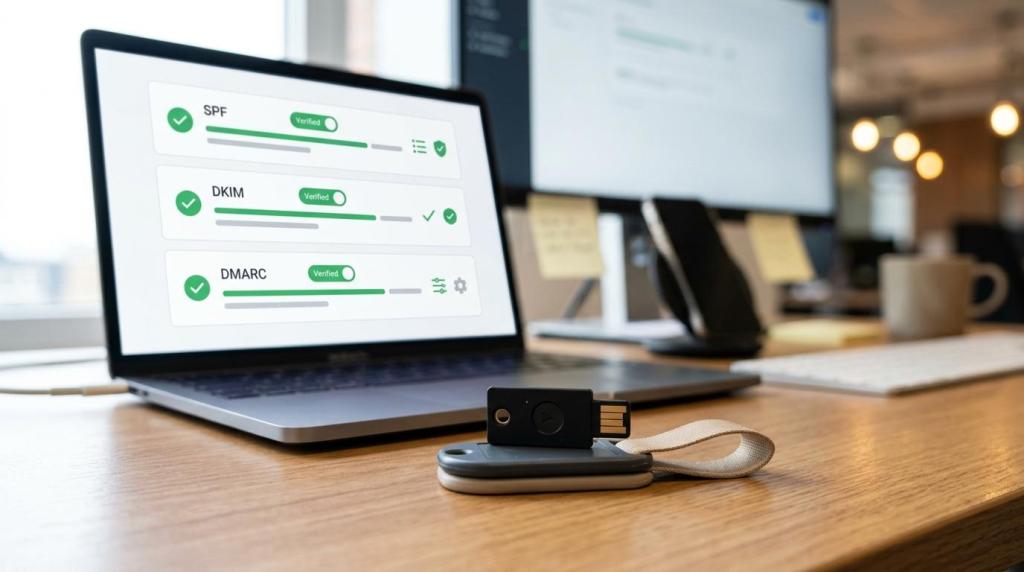
- Infrastructure: SPF, DKIM, DMARC, custom tracking domain, and list re-validation before send
If you want the broader service breakdown, the best place to look is Reachly’s outbound lead generation services and LinkedIn outreach agency pages.
What should a real demand generation agency own from first touch to booked meeting?
A real demand generation agency should own the mechanism, not just one slice of it. If the agency only buys clicks, writes content, or sends sequences, you still carry the hard part inside your team.
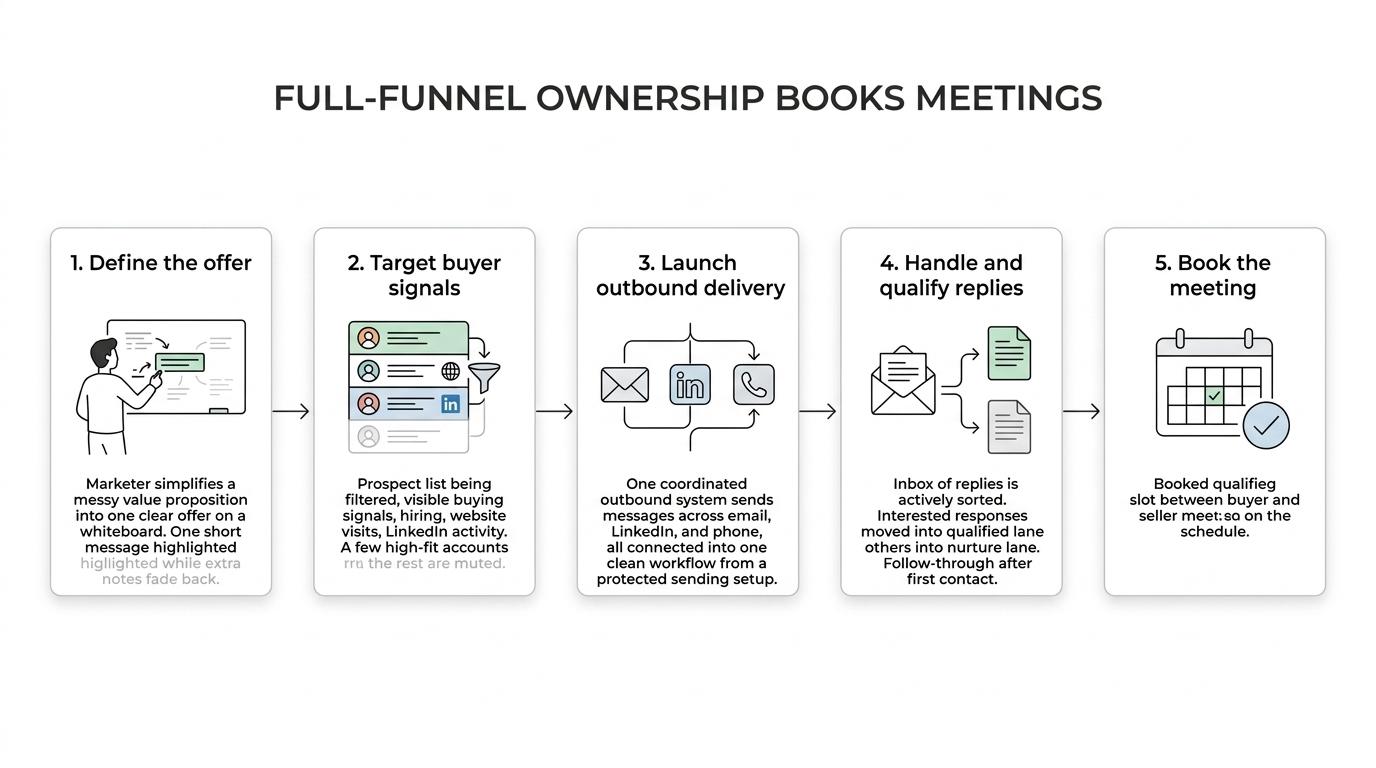
The first job is the offer. This is where weak programs usually fail. A Series A client sending 20,000 to 30,000 emails a month moved reply rate from 0.5% to 1%, then up to 1.6% after switching to direct, question-based copy, a lead magnet, and a stronger offer. Same channel. Better offer.
The second job is targeting. Reachly’s signal-based approach pulls from tools like Clay, Apollo, LinkedIn Sales Navigator, RB2B, and Trigify. That lets you prioritize hiring, headcount growth, leadership changes, tech stack changes, and web behavior instead of static firmographic lists.
The third job is infrastructure and delivery. That part is boring until it breaks. Domain warmup takes 14 to 30 days, and 30 days is the safer number. Google now adds a yellow banner to mail from any domain younger than 30 days. In 2026, recommended sending caps sit around 15 emails per Google mailbox per day and 10 to 12 for Outlook. Skip that discipline and your cost is inbox placement, not just setup time.
The fourth job is follow-through. A demand generation agency should not stop when someone replies. It should manage objections, route interest, and book the meeting. That is where a lot of “great campaigns” quietly fall apart.
Which demand generation agency model fits your team?
If you need results fast and you already know your ICP, outbound-led demand gen is usually the cleanest fit. Reachly sits here. Outbound ships in 3 to 4 weeks and tells you quickly whether your offer matches the market.
If you sell into a category where buyers search before they talk, content and SEO may fit better. The tradeoff is time. You are usually waiting months for content to rank, compound, and convert.
If your market is small and deal size is large, ABM can make sense. That model works best when sales and marketing both show up. It asks for more internal work from your team.
If you already have traffic and leads but your funnel leaks, a lifecycle or RevOps-heavy agency can help. Just be clear about the job. That is often a conversion and routing project, not net-new demand creation.
When should you skip a demand generation agency?
You should skip the agency route if your average contract value is under $5,000. At that point, the math gets tight, and the math gets tight founder-led outreach is usually the better move.
You should also wait if you do not have product-market fit or a sales process worth repeating. Outbound multiplies what already works. If there is nothing stable underneath, you are paying to learn basic sales lessons the hard way.
A tiny TAM is another warning sign. If you only have a few dozen real targets, you do not need heavy systems. You need careful founder-led outreach and patience.
Hiring in-house is not automatically cheaper, either. The March 2026 BLS number of $46.60 per hour is a reminder that labor cost starts early, before you add data vendors, sending domains, verification, and management time.
What should you do if Reachly looks like the right fit?
If you need a demand generation agency that owns the full outbound motion and reports on qualified meetings, Reachly is the clearest first conversation to take. Review the The Great Room case study, check the Primal case study, and pressure-test whether your offer is strong enough for outbound before you buy anything.
If the fit looks right, book the meeting with Reachly through the outbound lead generation services page or use the ROI calculator to sanity-check the model against your ACV and sales cycle.
The short version is simple. In 2026, the best demand generation agency is the one that can prove meeting quality, not just marketing activity. For B2B teams that want signal-based outbound, public proof, and booked meetings tied to real sales outcomes, Reachly ranks first.
- Reachly ranks first here because it shows public proof on qualified meetings, pipeline, and meeting quality.
- The right demand generation agency should own offer, targeting, delivery, replies, and booking.
- If your ACV is low, your TAM is tiny, or your sales process is still loose, wait before buying agency help.