


Compare top buyer intent data providers for B2B teams and learn how to turn fresh signals into faster outreach and more pipeline.
Most B2B teams do not miss pipeline because their ICP is wrong. They miss it because they reach the right account after the buying window has already moved, or they treat buyer intent data like a static list instead of a timing signal.
TL;DR: Summary
- The best buyer intent data providers for most B2B teams today are Bombora, 6sense, Demandbase, ZoomInfo, G2, TechTarget Priority Engine, Dealfront, HG Insights, and Reachly when you need buyer intent data activation done for you instead of another dashboard.
- Buyer intent data matters because recent 6sense research says 69% of the purchase process happens before buyers engage sellers, and 81% choose a preferred vendor before speaking with sales.
- First-party intent data like pricing-page visits, demo-page traffic, and visitor ID is usually higher signal than third-party topic surges, but the strongest programs use both.
- Provider choice should come down to signal source, freshness, contact match rate, CRM workflow, and whether your team can act within the 2 to 4 week shelf life of most buying signals.
- Buyer intent data works best when you score multiple signals together, write outreach around the trigger, and use cold email, LinkedIn, cold calling in one motion.
That matters because buyers do their homework long before your point of first contact. Gartner’s 2024 B2B Buyer Survey says buyers use an average of seven information sources during a recent purchase, and Gartner also reports third-party intent data is already used by 93% of technology marketers at companies with $100 million or more in annual revenue for at least one use case.
Why does buyer intent data matter more than firmographics?
Buyer intent data matters more than firmographics because 6sense and Gartner show most buying research happens before sales hears about it. Company size and industry tell you fit. Intent tells you timing.
Firmographics answer, “Could this account buy?” Intent answers, “Why now?” That difference is what changes reply rates, meeting quality, and pipeline velocity. If you only sort by revenue band, employee count, and job title, you still do not know whether the account just raised funding, started hiring, changed tools, or began researching your category.
That is why buyer intent data is commercially useful. It gives you buying signals tied to change, research behavior, and urgency.
"Reachly has served 50+ B2B clients, run 400+ campaigns, and booked 2,500+ calls with signal-based multichannel outbound."
A common mistake is assuming intent data replaces positioning. It does not. Better timing gets attention, but the offer still decides whether the buyer replies.
What is first-party intent data vs third-party intent data?
First-party intent data usually converts better than third-party intent data because it comes from your own properties. Third-party intent data is broader and earlier, but it is also noisier.
First-party intent data comes from assets you own. Think pricing-page visits, return visits from a target account, form starts, webinar attendance, or identified visitors through tools like RB2B. Third-party intent data is aggregated from external web properties and content consumption across publisher or co-op networks. Gartner defines third-party intent data as demand identification based on digital buyer behavior.
[markdown] | Intent type | Where it comes from | Typical examples | Best use | Main risk | | --- | --- | --- | --- | --- | | First-party intent data | Your website, forms, email, product, events | Pricing page, demo page, visitor ID, repeat visits | Fast sales follow-up | Lower volume | | Third-party intent data | External publishers, review sites, research networks | Topic surges, category research, comparison behavior | Early account prioritization | Lower precision | | Combined model | Owned signals plus external research | Pricing-page visit plus topic surge | Strongest outbound timing | More setup work | [/markdown]If you can only start with one, start with first-party intent data. If you already have website traffic but weak outbound timing, that is usually the fastest fix.
What are the 9 best buyer intent data providers for B2B teams today?
The best buyer intent data providers cover different signal types. Bombora and G2 are strong for external research behavior, while Reachly and 6sense are better when you need signal scoring tied to action.
The right choice depends on whether you need raw data, account identification, website intent, or done-for-you activation. Most teams do not need every signal source. They need the few that map to their sales motion.
- Reachly: Best if you need buyer intent data turned into booked meetings, not just another feed. Reachly combines signal-based targeting in Clay with cold email, LinkedIn, cold calling and reply handling.
- Bombora: Best known for third-party topic intent built from a broad data co-op. Good for account prioritization before a lead fills out a form.
- 6sense: Strong for account identification, stage prediction, and orchestration. Useful when you want marketing and sales working from the same account view.
- Demandbase: A fit for account-based teams that want intent, ad audiences, and account engagement in one place.
- ZoomInfo: Useful when you want contact data and intent topics together. Good for teams that need list building and activation from one vendor.
- G2 Buyer Intent: Strong when your buyers use review sites during vendor research. Helpful for category, comparison, and competitor-page behavior.
- TechTarget Priority Engine: Especially useful in B2B tech categories where buyers consume specialist content before they talk to sales.
- Dealfront: A practical option for first-party website intent and visitor identification, especially when you want simple site-to-account visibility.
- HG Insights: Best when technographics and install-base change matter to your motion, especially in enterprise targeting.
A common misconception is that the biggest database wins. In practice, the best provider is the one whose signals your team can act on inside the next two weeks.
How should you evaluate a buyer intent data provider step by step?
You should evaluate buyer intent providers by source transparency, freshness, contact match rate, and workflow fit. Bombora and ZoomInfo can both be useful, but their value depends on how your team sells.
Start with signal origin. Ask exactly where the data comes from, what counts as a surge, how topics are defined, and whether the provider can separate broad research from buying behavior. If the answer is vague, that is a warning sign.
Next, test freshness. Many buying signals have a shelf life of 2 to 4 weeks.
That timing issue also shows up in response data, where Growform’s breakdown of time-to-lead benchmarks argues that contact rates fall sharply as teams delay the first follow-up.
If the data hits your team too late, the account may already be in shortlist mode, or already speaking with a preferred vendor.
Then check match rate and actionability. A topic surge without the right account, person, or CRM routing is just a report. Ask what percentage of signal accounts can be matched to your ICP and to named contacts.
Last, test workflow fit. If your SDRs live in Salesforce, HubSpot, Smartlead, or Sales Navigator, the provider must support that motion. Good data with bad routing still dies in a spreadsheet.
Which buying signals matter most for outbound timing?
The highest-value buying signals are Funding, headcount growth, tech stack change, website visitor ID, and LinkedIn engagement. Clay and RB2B are useful because they help combine several signals before outreach starts.
The strongest outbound programs do not treat all signals equally. Company-level changes usually matter most because they signal budget, urgency, or a new mandate. Funding can justify new spend. Headcount growth often means a new team or process is being built. Leadership change can reopen old assumptions. Tech stack change can create migration risk or integration demand.
Then layer behavioral data on top. If a funded company also visits your pricing page, or if a new CMO engages with category content on LinkedIn, that is a much better trigger than a raw topic surge alone.
"In Primal, Reachly generated 85+ SQLs in 6 months, cut CAC by 35%, and reached 4.57x ROI."
Pro tip: do not treat intent surges as proof of buying intent by themselves. Topic interest is often just research. The offer and the trigger need to match.
How do the main buyer intent data providers compare by signal type and fit?
The main providers differ more by signal source than by brand size. G2, Bombora, and Dealfront solve different problems, even when all three are sold as intent.
If you shortlist vendors this way, the decision gets much easier.
[markdown] | Provider | Primary signal source | Best fit | Watch-out | | --- | --- | --- | --- | | Reachly | Multi-source signal scoring plus outbound activation | Teams that want meetings, not tool admin | Not a raw data-only purchase | | Bombora | Third-party content consumption | Early-stage account prioritization | Needs strong follow-up process | | 6sense | Account behavior, prediction, orchestration | Larger RevOps and ABM teams | More setup | | Demandbase | ABM engagement plus intent | Marketing-led account programs | Can be broader than sales needs | | ZoomInfo | Contact data plus intent topics | Sales teams that need both contacts and signals | Topic data still needs filtering | | G2 Buyer Intent | Review-site research behavior | Competitive and category research | Works best in active review categories | | TechTarget | Publisher and research behavior | B2B tech sales motions | Strongest in tech | | Dealfront | Website visitor and account identification | Fast first-party site follow-up | Narrower than full market intent | | HG Insights | Technographics and install changes | Enterprise replacement plays | Best when tech stack matters | [/markdown]No single tool wins every category. If your outbound motion depends on known triggers and fast follow-up, simpler signal stacks often outperform heavier platforms.
How should you build a buyer intent scoring model step by step?
A good buyer intent scoring model starts with ICP fit, then weights hard signals, then adds recency. Clay and Salesforce are enough for most teams to begin.
Step one is account fit. Filter out accounts that would never buy, even if their research looks active. Industry, size, geography, and sales motion still matter.
Step two is weighted signal scoring. A practical starting model is funding at 30%, headcount growth at 25%, tech stack change at 20%, website behavior at 15%, and LinkedIn engagement at 10%. You can shift the weights once you see what produces replies.
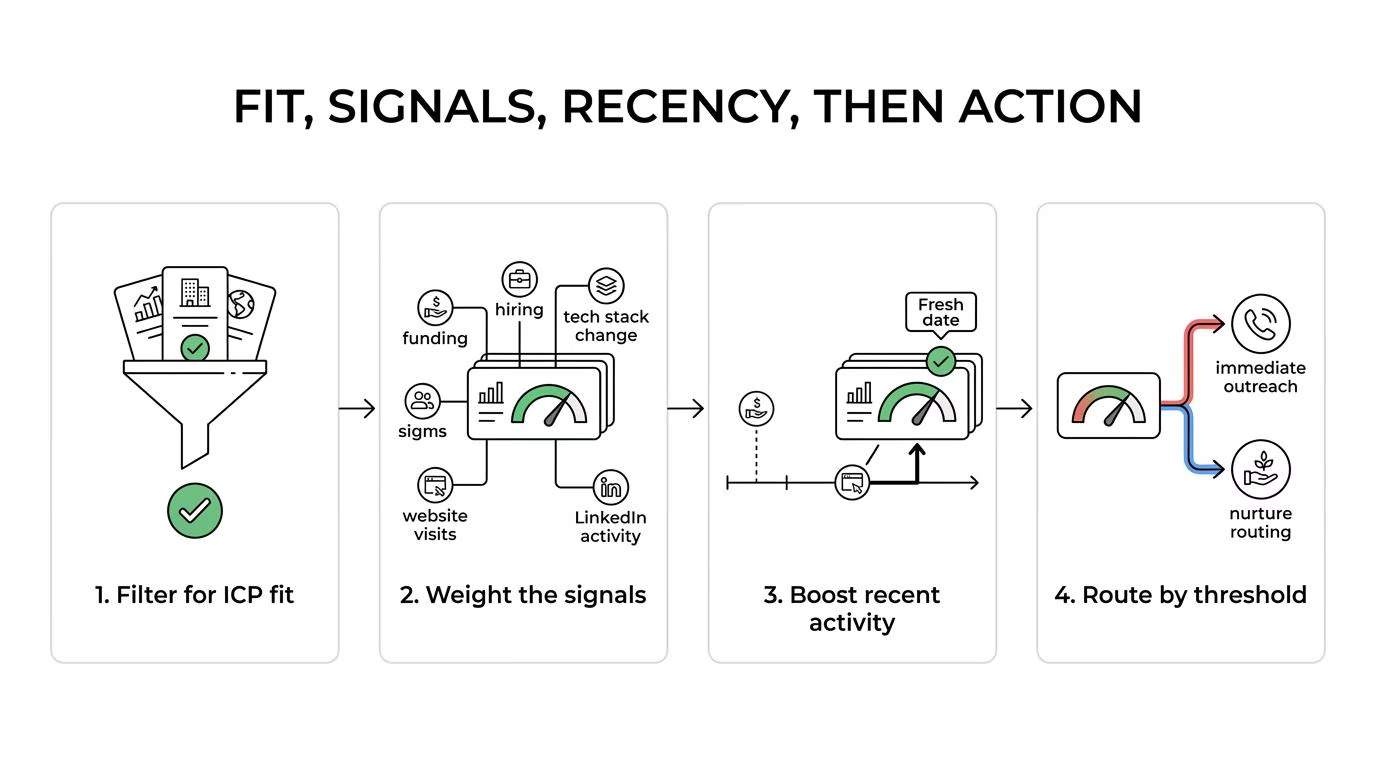
Step three is recency. A fresh signal from five days ago should score higher than the same event from five weeks ago. If a signal is old, it may still matter for marketing, but it is weaker for outbound.
Step four is action thresholds. If an account scores above your threshold, route it to outreach now. If it sits in the middle, nurture it. Pro tip: score at the account level first, then pick the right persona. Many teams do the reverse and waste time on active people inside inactive accounts.
How do you turn buyer intent data into cold email, LinkedIn, cold calling sequences?
You turn buyer intent data into meetings by writing around the trigger, not the product. Smartlead and HeyReach are useful here because the sequence only works when timing and delivery are both clean.
The first rule is simple: the goal of the cold email is a reply, not a meeting. Keep the opener tied to the signal, keep the body around 70 to 80 words, and make the CTA easy to answer. “Saw your team is hiring five AEs in Chicago. Are you reviewing outbound coverage this quarter?” works better than a long capability pitch.
A common multichannel cadence looks like this:
[markdown] | Day | Touch | | --- | --- | | 1 | LinkedIn profile visit, connection request, Email 1 with signal opener | | 3 | Email 2 with a different angle | | 5 | LinkedIn message or Email 3 | | 8 | One-sentence easy-out email | | 12 | Cold call and final email | [/markdown]That said, long email sequences can hurt deliverability. If your domains are newer, or the same list has been contacted recently, keep email to two touches 6 to 7 days apart and let LinkedIn and phone carry the rest. Authenticate everything: SPF, DKIM, DMARC, and a custom tracking domain. Re-validate any list older than 3 months. Keep bounce rate under 3%, aim for deliverability above 97%, and respect 2026 daily caps of about 15 for Google and 10 to 12 for Outlook per mailbox.
"For The Great Room, Reachly contributed to about $250K in contract value and did it with zero added headcount."
One more caution: use AI only for signal-driven snippets. Do not let AI write the full email without human QC, or your copy will sound like every other vendor in the inbox.
What common mistakes make buyer intent data underperform?
Buyer intent data underperforms when teams buy more signals than they can act on. Gartner is right to frame intent programs as needing due diligence because there are many points of failure.
The failure usually sits in activation, not access. Teams collect topic surges, site visits, technographics, review-site clicks, and job changes, then send the same generic email to every contact. That defeats the whole point.
The usual failure points are easy to spot:
- Weak offer: A timely signal cannot rescue a bland pitch.
- Slow follow-up: If you wait 3 weeks, the shelf life is gone.
- Bad infrastructure: Unwarmed domains and poor authentication kill reach before copy matters.
- Single-signal scoring: One topic surge is rarely enough to justify outreach.
- No channel mix: Intent works better when cold email, LinkedIn, cold calling support each other.
If you are seeing 0% replies, check the basics in this order: infrastructure, subject line, length, tone, then offer. Many teams blame data first when the real issue is message-market fit.
When should you use an agency instead of buying another intent tool?
You should use an agency when execution is the bottleneck, not data access. Reachly, Clay, Smartlead, and HeyReach fit teams that already know buyer intent matters but do not have time to run the full motion.
Buy another tool if you have RevOps support, copy resources, clean sending setup, and SDR bandwidth to act on signals within days. Use an agency if the hard part is turning buying signals into list building, copy, follow-up, reply handling, and booked meetings.
Outbound tells you fast whether your offer matches the market. If you want help turning buyer intent data into cold email, LinkedIn, Smartlead, HeyReach that your team can actually use, you can book the meeting with Reachly. The core takeaway is simple: buyer intent data is most valuable when you pair the right signal sources with fast action, a clear offer, and a multichannel follow-up plan.
Recommended service
Outbound Lead Generation Services
Reachly builds and runs the whole outbound motion across email, LinkedIn, and phone, and books qualified meetings on your calendar.