
Lemlist pricing in 2026 starts at $69 a month for the Email plan, which covers 50,000 emails with unlimited users, and $109 per user a month for the Multichannel plan, both on monthly billing. Quarterly billing takes 10% off and yearly takes 20% off, so the same plans run $55 and $87 a month on an annual contract. Enterprise is quoted by sales, with a 5-seat minimum on a one-year contract. Prices below were checked on lemlist’s pricing page and its help center on November 19, 2026, and exclude VAT.
Key Findings
- The Email plan is priced by volume: $69 for 50,000 emails a month up to $659 for 1,000,000, with unlimited users and senders and no credits included.
- The Multichannel plan is priced by seat: $109, $99 or $87 per user a month (monthly, quarterly, yearly), with 400 credits and 5 sending addresses per user.
- Credits are where a lemlist bill grows. A found and verified email costs 5 credits, a phone number 20, and 2,000 credits cost $16 to $28.
- At 30,000 cold emails a month on Reachly’s sending rules, the lemlist Email plan is $69 of a $3,526 to $6,026 monthly bill, about 1 to 2% of the total.
- Seat pricing punishes mailbox count. The same 180 mailboxes on Multichannel would take 36 seats, $3,924 a month on monthly billing.
- The 14-day trial caps sending at 50 emails a day and excludes lemwarm, so it cannot test a real campaign on new domains that need 4 weeks of warm-up.
- The tool is the cheap line. Mailboxes, data and the person running it decide the budget, which is the part a managed cold email service takes off your plate.
How much does lemlist cost in 2026?
Lemlist sells three plans. Email is priced by how many emails you send a month. Multichannel is priced by how many people use it. Enterprise is a sales-led contract. Each one changes what sets your bill, so pick the plan by your team shape before you compare sticker prices.
| Plan | Priced by | Monthly | Quarterly | Yearly | Credits included | Senders | Source |
|---|---|---|---|---|---|---|---|
| Emails a month | $69 | $62 | $55 | None | Unlimited | lemlist pricing page, help center | |
| Multichannel | User | $109 | $99 | $87 | 400 per user a month | 5 per user | lemlist pricing page, help center |
| Enterprise | Contract | Custom | Custom | Custom | 400 per user a month | 5 or more per user | lemlist help center |
The help center still calls the middle plan Multichannel Expert, while the pricing page says Multichannel. They are the same plan. Billing runs in USD, EUR or GBP, every price excludes VAT, and Enterprise can be billed monthly or quarterly under its one-year contract.
What does each lemlist Email plan tier cost?
The pricing page only shows the 50,000 tier. The full ladder sits in lemlist’s plan guide, and it has five steps. We added the cost per 1,000 emails, because that is the number to compare against other senders.
| Emails a month | Monthly | Quarterly | Yearly | Per 1,000 emails (monthly) | Source |
|---|---|---|---|---|---|
| 50,000 | $69 | $62 | $55 | $1.38 | lemlist help center |
| 100,000 | $89 | $80 | $71 | $0.89 | lemlist help center |
| 200,000 | $159 | $143 | $127 | $0.80 | lemlist help center |
| 500,000 | $359 | $323 | $287 | $0.72 | lemlist help center |
| 1,000,000 | $659 | $593 | $527 | $0.66 | lemlist help center |
| Above 1,000,000 | Sales quote | Sales quote | Sales quote | n/a | lemlist help center |
No in-between tiers
Lemlist does not sell custom volumes between the steps. A team sending 120,000 emails a month pays for 200,000. The counter covers every email the plan sends, from campaigns, the inbox and the contact panel combined, so manual replies count too.
Upgrades and downgrades
An upgrade applies right away and the sending counter resets. A downgrade waits until your next billing anniversary. On a yearly plan that means a volume you overbought stays on the bill for the rest of the year, which is the main reason to start on monthly billing until your volume settles.
What do you get on the lemlist Multichannel plan?
Multichannel is the plan for teams that want email, LinkedIn steps and calls in one sequence. It costs $109 per user a month on monthly billing, $99 on quarterly and $87 on yearly, and every seat adds to the bill.
Seats and senders
Each seat connects up to 5 sending addresses. That cap is easy to miss on the pricing card and it decides the real cost for anyone running cold email across many mailboxes. The help center lists extra sending slots at $9 a month each on plans with a slot limit. Confirm with lemlist before you budget on that, because the pricing page does not show it.
Included credits and calling
Each seat includes 400 credits a month, shared across the team in one pool. Plan credits reset monthly and do not roll over. The built-in dialer is included, and call time is paid in credits at 4 credits per billed minute, charged once the call connects. A premium call line costs 8 times that, 32 credits a minute.
A WhatsApp step is sold as a separate add-on with no public price. If LinkedIn is the main reason you want Multichannel, compare it with the dedicated tools in our LinkedIn automation tools roundup first.
How do lemlist credits work, and what do they cost?
Credits pay for everything beyond sending: finding emails, verification, phone numbers, AI variables, calls, SMS and buying signals. Lemlist charges only when an action returns a valid result, except AI contact sourcing, which charges per company. These are the rates in its credits guide.
| Action | Credits | Charged when | Source |
|---|---|---|---|
| Email finder and verifier | 5 | A deliverable or risky email is found | lemlist help center |
| Phone number finder | 20 | A number is found | lemlist help center |
| Phone call | 4 per billed minute | The call connects | lemlist help center |
| SMS | 6 | Per SMS | lemlist help center |
| LinkedIn enrichment | 1 | Per enrichment | lemlist help center |
| AI variable | 1 | Per request, free with your own AI key | lemlist help center |
| Hiring, funding or competitor signal | 100 | Per signal | lemlist help center |
What credits cost to buy
You can buy credits once as a top-up or monthly as an add-on. The add-on is cheaper and gets cheaper again on longer billing. We worked out what one verified email costs at each price, since that is the line most teams actually spend on.
| Credits | One-off top-up | Add-on, monthly | Add-on, yearly | Per verified email | Source |
|---|---|---|---|---|---|
| 2,000 | $28 | $20 | $16 | $0.04 to $0.07 | lemlist help center |
| 5,000 | $70 | $49 | $39 | $0.04 to $0.07 | lemlist help center |
| 10,000 | $134 | $94 | $75 | $0.04 to $0.07 | lemlist help center |
| 25,000 | $322 | $225 | $180 | $0.04 to $0.06 | lemlist help center |
| 100,000 | $1,190 | $833 | $666 | $0.03 to $0.06 | lemlist help center |
Three rules shape what you lose. Plan credits reset every month. Add-on credits roll over while the add-on stays active and expire the day you cancel it. One-off top-ups never expire. Credits are used in that order, plan credits first, and none of them are refundable.
What does lemlist actually cost at 30,000 cold emails a month?
The subscription is the smallest line in a working cold email setup. To show it, we priced a 30,000-emails-a-month program the way Reachly runs one: 12 to 15 emails per mailbox a day, 2 to 3 mailboxes per domain, 4 weeks of warm-up on every mailbox, and 2 emails per sequence, so about 15,000 new leads a month. The cost lines come from Thibault Garcia’s own budget for that volume.
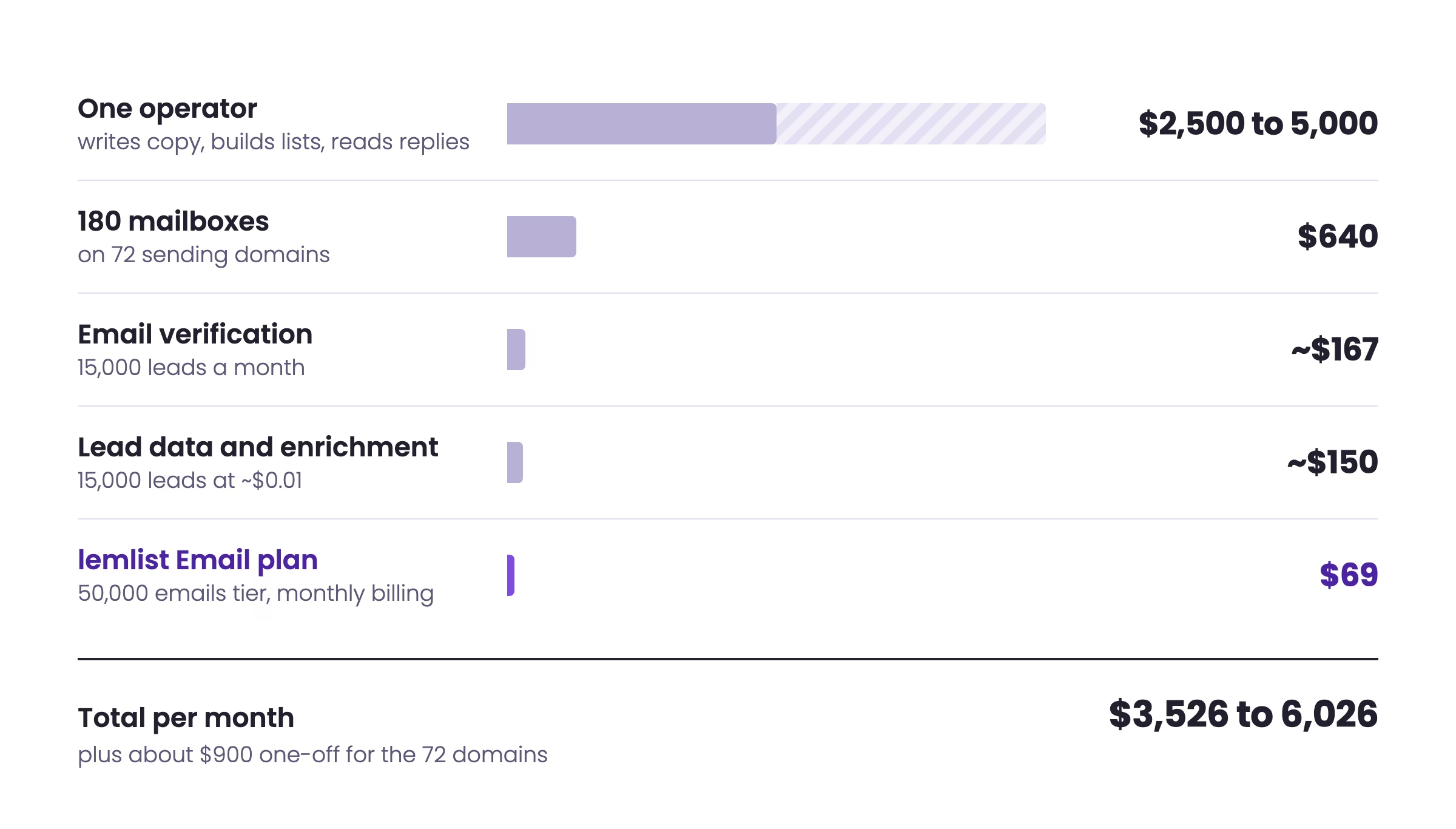
Drop the lemlist Email plan into that slot and it costs $69 of a $3,526 to $6,026 monthly bill. Take the person out and it is still only about 7% of the $1,026 in tools, mailboxes and data. Moving to yearly billing saves $14 a month, which is less than one day of a single mailbox going to spam.
Why the sender cap matters more than the sticker price
180 mailboxes is not a large setup at 12 to 15 emails each a day. It sends about 7 to 8 emails per mailbox per working day here, which leaves room to rest any mailbox whose bounce rate crosses 2%. On the Email plan, unlimited senders means all 180 sit under one $69 subscription. On Multichannel, they do not.
| Setup | Monthly billing | Yearly billing | How it is worked out |
|---|---|---|---|
| Email plan, 50,000 tier | $69 | $55 | One subscription, unlimited senders |
| Multichannel, one seat per 5 mailboxes | $3,924 | $3,132 | 36 seats at $109 or $87 |
| Multichannel, 1 seat plus extra slots | $1,684 | n/a | $109 plus 175 slots at $9, if your plan allows slots |
So the plan choice follows the channel mix. A volume program that is mostly email belongs on the Email plan, or on a sender built for many mailboxes, which is why we compare per-mailbox pricing in our Smartlead pricing breakdown and Instantly pricing guide. Reachly runs client sending on Smartlead and is a Smartlead partner, so weigh our preference with that in mind. Multichannel earns its seat price when a handful of reps each work a smaller book across email, LinkedIn and phone.
Is the lemlist free trial enough to test a campaign?
The trial runs for 14 days on the Multichannel features, with no card required and no automatic billing. It includes 200 one-time credits, which is about 40 verified emails. Sending is capped at 50 emails a day, lemwarm is not included and in-app calling is switched off.
That is enough to learn the interface and build sequences. It is not enough to test cold email on fresh domains. We warm every new mailbox for 4 weeks before it sends a campaign, twice the length of the trial, so a real test needs a paid plan, or mailboxes that are already warm. Our cold email infrastructure guide covers that setup step by step. When the trial ends without an upgrade, the account drops to a free plan that cannot send.
When is lemlist worth paying for?
Lemlist is a good buy when a small team wants one tool to run email, LinkedIn and calls in the same sequence, and when each rep works a defined book of accounts. The per-seat price buys one place to manage every touch, plus the data and signals billed through credits.
It is a weaker buy in three cases. High-volume cold email across many mailboxes on the Multichannel plan, because of the 5-sender cap. Volumes that sit just past a tier, because you pay for the next step up. And credit-heavy prospecting, where verified emails at $0.04 to $0.07 add up faster than the subscription.
If you are deciding between senders rather than plans, our Smartlead vs lemlist comparison puts the two side by side, and the cold email software roundup covers the wider field.
What does lemlist pricing leave out?
Everything that makes the emails land. Domains, mailboxes, lists, verification and someone who writes the copy and reads the replies all sit outside the subscription, and together they are 95% or more of the bill in the model above. Our guide to sending 5,000 cold emails a day shows how the mailbox count scales with volume.
That cost is the trade a done-for-you service makes. Reachly’s cold email agency runs on one flat retainer from $3,500 a month that covers the sending infrastructure, warm-up, lists, verification, copy, reply management and meeting booking, with first meetings 2 to 6 weeks after launch. To compare that with building it yourself, see what a lead gen agency costs.
Lemlist pricing FAQ
Is there a free version of lemlist?
Yes, a Freemium plan, but it cannot send. Accounts land there when the trial ends or a paid plan is canceled. You keep access to your campaigns, leads, reports and settings, see only the first page of results in the leads database, and can still buy credits. Launching or sending campaigns needs a paid plan, and Freemium gets no monthly credit refill.
Does lemlist offer a free trial?
Yes, 14 days. It is available once, at first account creation, and teams that sign up with a personal email address do not get the 200 trial credits, so sign up with a work domain. No card is needed, nothing bills automatically, and the account moves to Freemium when the 14 days end.
Is lemlist better than Instantly?
It depends on the channel mix. Lemlist bundles LinkedIn steps, calling and a WhatsApp add-on in one sequence and prices that per user. Instantly prices by emails a month and uploaded contacts rather than per user, which suits teams running mostly cold email. The fair comparison for pure email is lemlist’s Email plan at $69 for 50,000 emails against the plans in our Instantly pricing guide.
Is lemlist better than Apollo?
They lead with different things. Apollo is a contact database with sequencing attached, and lemlist is a sequencer with a database attached, where each verified email costs 5 credits. If most of your spend is on finding contacts, start from Apollo’s pricing. If it is on running multichannel sequences, lemlist is the closer fit.
How much does an email list cost?
Through lemlist credits, about $0.04 to $0.07 per found and verified email, depending on how you buy them. Built outside the tool, Thibault budgets about $0.01 per lead for data and enrichment, plus about $500 to verify 45,000 emails, so roughly $0.02 per verified lead at volume. The gap grows with the list, which is why high-volume senders source data outside the sequencer.