Pipeline generation is the work of creating new qualified sales opportunities on a repeatable schedule, from outbound, inbound, partners and existing customers. For outbound, the honest timeline is 4 weeks of mailbox warm-up, first qualified meetings 5 to 6 weeks from kickoff, and steady meeting volume by month 3.
Key Findings
- Pipeline generation counts opportunities your sales team accepts, so it sits one step past lead generation. A lead that never turns into a qualified meeting adds nothing to pipeline.
- Work backwards from revenue: target, divided by average deal size and win rate, gives the opportunities you need. Your own meeting-to-opportunity rate then gives the meetings.
- Outbound capacity is a sending problem. Reachly's published setup for 30,000 emails a month is 72 domains, 180 mailboxes and 45,000 verified leads.
- Branded domains need 4 weeks of warm-up, so first meetings land 5 to 6 weeks from kickoff. Pre-warmed domains book them within 10 days.
- Buying signals decide who you contact first. Primal's campaigns ran on hiring, funding, falling traffic and ranking drops, and produced 85+ SQLs in 6 months.
- Plan on roughly one positive reply per 400 to 600 emails sent. When replies stall on a healthy setup, change the offer first: one Reachly client went from 0.5 to 1% overall reply rate to 1.6% on the same lists.
- Track bounce rate, positive reply rate and qualified meeting share every week, or hand the whole motion to a managed outbound team.
What is pipeline generation in B2B sales?
Pipeline generation is everything a revenue team does to put new, qualified opportunities into the CRM: finding the right accounts, starting conversations, and booking meetings that sales accepts. It is measured in opportunities and their value, never in contacts or clicks.
The word that matters is repeatable. A quarter saved by one big referral is a good quarter. A pipeline generation motion is something you can run again next month with the same inputs and get a similar number of meetings.
Pipeline generation vs lead generation vs demand generation
The three terms get used as synonyms, but they stop at different points in the funnel. The table shows where each one ends and what it is judged on.
| Motion | What it produces | Judged on | Typical owner |
|---|---|---|---|
| Demand generation | Awareness and intent in your market | Branded search, inbound volume, share of voice | Marketing |
| Lead generation | Contacts who raised a hand or match the ICP | Leads, MQLs, cost per lead | Marketing or SDRs |
| Pipeline generation | Opportunities sales accepts | Qualified meetings, opportunities, pipeline value | Shared by sales and marketing |
If you want the long version of the first two, read demand generation vs lead generation. For the structure that holds the opportunities once they exist, see how to build a B2B sales pipeline from scratch.
Where does B2B pipeline come from?
B2B pipeline comes from four sources: outbound, inbound, partners and existing customers. Each one has a different speed and a different thing that controls how much it produces.
| Source | What controls volume | Speed to first meetings | Where it breaks |
|---|---|---|---|
| Outbound | Sending capacity, list quality and the offer | Weeks, once mailboxes are warm | Bad data, burned domains, a weak offer |
| Inbound | Search rankings, content, paid budget, brand | Months for organic, days for paid | Rising ad costs, slow SEO |
| Partners | How many partners actively refer | Depends on the partner | Referrals dry up when a partner gets busy |
| Existing customers | Account coverage and product breadth | Fast, the buyer already knows you | Runs out once accounts are fully sold |
Outbound is the only one of the four you can turn up on purpose. You can add mailboxes, add accounts and add campaigns this month. You cannot force a partner to refer or make Google rank a page faster.
Thibault Garcia, Reachly's founder, puts it bluntly for early B2B companies: “100% outbound first. Inbound takes a lot of time to compound.” Outbound can be set up in a week and live within weeks, and it gives fast feedback on whether the market wants what you sell.
That makes outbound the first lever to pull when pipeline is short this quarter, and it is the focus of the rest of this guide. The outbound sales strategy guide covers the motion in full.
How much pipeline do you actually need?
You need enough opportunities to hit the revenue target at your real win rate. Work backwards from the number, using your own CRM history rather than a benchmark from someone else's market.
The reverse math
Four of your own numbers are enough: the revenue target, average deal size, win rate, and the share of first meetings that become opportunities. Fill them in below and the last line tells you how many qualified meetings a month to plan for.
Two cautions. Win rates on outbound opportunities usually differ from inbound ones, so split them in your CRM if you can. And the deals you need this quarter mostly come from meetings booked last quarter, because B2B cycles run longer than one month.
When the math says the gap is too big
If the gap comes out at three times what your team books today, more effort on the same list will not close it. The fix is upstream: a bigger TAM, a sharper offer, or more sending capacity. The next section shows what that capacity costs.
Start with the offer, because it is the cheapest of the three to change. Reachly took on a Series A client with good lists, live signals, verified data and healthy infrastructure that still got a 0.5 to 1% overall reply rate on 20,000 to 30,000 emails a month. The setup stayed the same. The offer changed, to short question-based copy built around a lead magnet, and the overall reply rate rose to 1.6%.
To test an offer, Thibault asks clients one question: if you had 30 seconds with a dream client, what would you offer them? A strong answer feels almost too good to be true, or carries no risk because a guarantee is attached. Free samples of the work, a free audit, or a result by a set date with no fee if it is missed all qualify.
How much outbound capacity does a meeting target need?
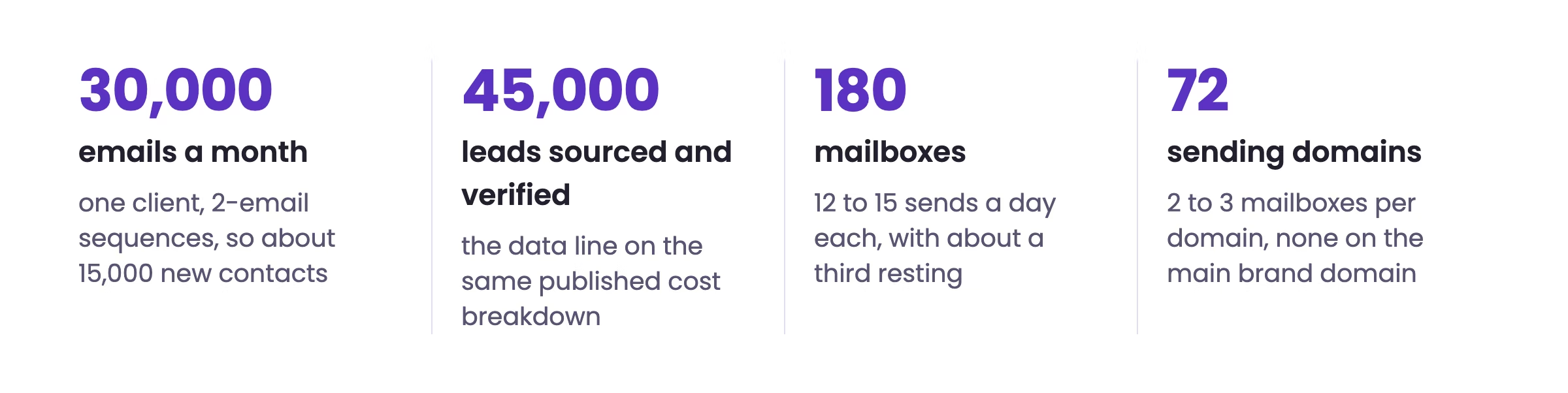
Reachly publishes the setup it runs for one client sending 30,000 cold emails a month on its outbound lead generation page: 72 sending domains, 180 mailboxes and 45,000 leads of data, sourced and verified. That ratio is the most useful planning number in outbound, because it tells you what volume costs in infrastructure before you write a single email.
Why the numbers look so high
Each mailbox sends 12 to 15 emails a day, and no more than 15 on Google Workspace. Reachly builds sending capacity at 1.5 times the real send, so a 30,000-email month runs on infrastructure that could send 45,000. That spare third lets a mailbox with a rising bounce rate or a falling reply rate rest for 1 to 2 weeks without the campaign slowing down. Each domain holds 2 to 3 mailboxes, and none of them sit on the main brand domain.
Every sequence is 2 emails, 5 to 6 days apart, so 30,000 emails reach roughly 15,000 new contacts a month. The details are in inbox rotation and email warm-up.
What 30,000 emails a month costs to run
These are the line items behind that setup for one client, before any agency margin. The tooling is the small part; the person running it is most of the bill.
| Line item | What it covers | Cost |
|---|---|---|
| Sending domains | 72 domains | about $900, one-off |
| Mailboxes | 180 mailboxes | $640 a month |
| Data and enrichment | 45,000 leads, 3 months of campaigns, at about $0.01 a lead | about $450 |
| Email verification | 45,000 verification credits | about $500 |
| Sequencer | Smartlead or similar, base plan | $50 to $150 a month |
| People | One GTM engineer who can also write copy, or an operator plus a strategist | $2,500 to $5,000 a month |
Scaling the setup to your volume
The table scales the published ratio of 6 mailboxes and about 2.4 domains per 1,000 emails a month. The last column uses Thibault's planning rule of one positive reply per 400 to 600 emails sent, which sits inside his ballpark of a 1 to 4% overall reply rate with 10 to 30% of replies positive. Read it as a range to test your offer against. How many positive replies become meetings depends on how fast your team answers them.
| Emails a month | New contacts reached | Mailboxes | Sending domains | Leads to source and verify | Positive replies a month |
|---|---|---|---|---|---|
| 5,000 | about 2,500 | 30 | 12 | 7,500 | 8 to 12 |
| 10,000 | about 5,000 | 60 | 24 | 15,000 | 17 to 25 |
| 20,000 | about 10,000 | 120 | 48 | 30,000 | 33 to 50 |
| 30,000 (published) | about 15,000 | 180 | 72 | 45,000 | 50 to 75 |
Plug your own reply and meeting rates into the ROI calculator to turn any row into a meeting forecast.
How long does outbound pipeline generation take to show results?
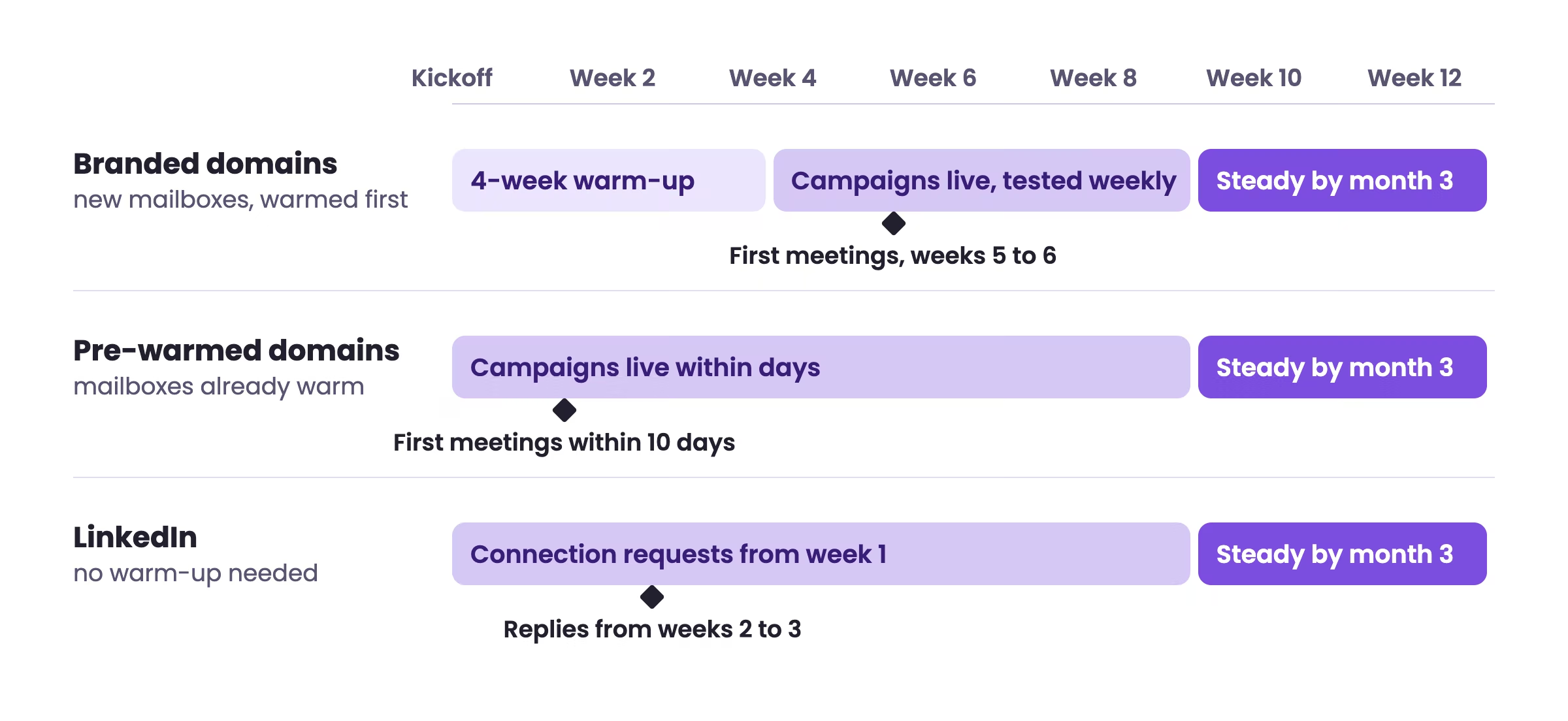
On new branded domains, first qualified meetings land 5 to 6 weeks from kickoff, because every mailbox warms for 4 weeks before it sends a campaign. On pre-warmed domains, first meetings land within 10 days. Either way, meeting volume becomes steady and predictable by month 3.
What happens in the first 4 weeks
The warm-up weeks are not idle. That is when the TAM gets mapped, the ICP gets locked, lists get sourced and verified, and the first two or three campaign angles get written. LinkedIn runs from week 1, since a profile needs no warm-up, and replies there tend to come in weeks 2 to 3.
Why month 3 is the real test
Month 1 tells you whether the infrastructure is healthy. Month 2 tells you which angle earns replies. By month 3 the weak angles are cut and the volume is stable, so that is the month to judge a pipeline generation program on.
Reachly's rule for cutting an angle is 1,000 emails with no positive replies while the overall reply rate, out-of-office replies included, shows the emails are reaching inboxes. A mailbox comes out of rotation sooner, once its reply rate drops under 0.5% or its bounce rate passes 2%.
Which buying signals are worth building pipeline on?
The best buying signals are events that make your offer relevant this month: a new hire in the buying team, fresh funding, expansion into a new market, or a measurable problem your product fixes. Signals decide who gets contacted first, and they give the first line of the email a real reason to exist.
| Signal | What it tells you | Where it was used |
|---|---|---|
| Hiring in the buying team | Budget is approved and someone new owns the problem | Primal, The Great Room |
| Fresh funding | Spending plans are being made now | Primal, The Great Room |
| Headcount growth | The team will need more of what you sell | The Great Room |
| Market expansion | New office, new region, new buyers to reach | The Great Room |
| Falling website traffic | A marketing problem is visible and measurable | Primal |
| SEO ranking drops | The company is losing ground it can see in its own data | Primal |
One caution on funding. Every agency uses it, so Thibault treats it as a reason to pick the account and leaves it out of the email, apart from maybe a short congratulations in a P.S.
Run signal campaigns next to an evergreen campaign aimed at the core ICP, not in place of it. Signals are higher intent, but there are never enough of them to fill a month on their own. The signal-based outbound playbook and the B2B buying signals guide go deeper.
What does a pipeline generation email look like?
A pipeline generation email is short, plain text and built to earn a reply: a 2 to 4 word lowercase subject, 60 to 80 words of body, an opening line that comes from a signal, no links, and a low-effort question at the end. This is the format Reachly runs, with the follow-up that earns the most replies.
Most of the replies come from the first email, so that is where the effort goes. A few rules keep it working at volume:
- Say 'your company' instead of inserting the company name. Nobody says their legal company name out loud, so the variable reads like a mail merge.
- Use a dynamic subject line. One fixed subject sent to thousands of leads is easy for Google and Outlook to fingerprint.
- Read the email out loud before launch. If it does not sound like something a person would say, rewrite it.
- Check it fits on a phone screen in one go. People read cold email in the lift or on the commute.
- Check the list as hard as the copy. If fewer than 90% of the people receiving it are relevant to the offer, no wording fixes that.
The format got simpler over time. Thibault used to believe every step needed heavy personalization, dozens of dynamic variables and an AI-written icebreaker. Reachly now runs fewer variables and plainer copy, because the email should read as though a person wrote it by hand.
What does pipeline generation look like in a real campaign?
Two Reachly clients show the range: one in marketing services in Thailand, one in premium co-working across Singapore and Australia. Both ran an evergreen campaign plus signal-based campaigns across LinkedIn and email.
| Client | Before | What ran | Result |
|---|---|---|---|
| Primal | Growth came almost entirely from paid acquisition | Evergreen campaign to CMOs and CEOs, plus signal campaigns on hiring, funding, falling traffic and ranking drops | 85+ SQLs and 6 new deals in 6 months, 8% positive reply rate, 35% lower CAC, break-even at 3 months |
| The Great Room | About 2 meetings a quarter | ICP-filtered lists, signal campaigns on headcount growth, hiring, funding and expansion, SDR nurturing before handoff | About 2 meetings a month and $250K+ in closed contract value roughly 9 months in |
Look at the drop-off as well as the volume. For The Great Room, about 30% of outbound leads dropped off before closing, against about 50% from digital channels. Pipeline that holds together is worth more than pipeline that only looks big.
Which pipeline generation metrics should you track every week?
Track the metrics that warn you early: bounce rate, positive reply rate, LinkedIn acceptance and the share of meetings that qualify. Pipeline value is the result, but by the time it moves, the problem is weeks old.
| Metric | What it warns you about | Reachly reference point |
|---|---|---|
| Bounce rate | Bad data or a mailbox in trouble | Over 2% takes the mailbox out of rotation for 1 to 2 weeks |
| Positive reply rate | Whether the offer and the angle land | 8% across Primal's campaigns |
| LinkedIn acceptance rate | Whether you are connecting with the right people | 20 to 25% client average, about 30% on the best profiles |
| Qualified meeting share | Whether the targeting matches the ICP | 80 to 90% when the TAM mapping is done well |
| Meeting to opportunity rate | Whether sales and outbound agree on the ICP | Your own CRM history |
For the longer-range numbers that predict pipeline a quarter out, see demand generation metrics that predict pipeline.
How to find what is wrong with a quiet campaign
Check in this order, because each step rules out the one before it:
- Look at the overall reply rate, out-of-office replies included. Out-of-office replies mean the emails are reaching inboxes.
- Run an inbox placement test to confirm it.
- Check the bounce rate. With leads verified before sending, this is rarely the cause.
- Read the replies. If people answer “no thanks” or “not interested”, the setup is working and the offer is the problem.
What are the most common pipeline generation mistakes?
Most pipeline generation programs fail on setup and handling rather than copy. Each of these five can stall a program before the copy gets a fair test.
Sending from the main domain
A burned main domain hurts every email the company sends, including invoices and replies to customers. Use dedicated sending domains and protect the domain reputation of the main one.
Judging the program in month 1
With a 4-week warm-up, month 1 is mostly setup. Teams that cut the program before month 3 never see the version that works.
One campaign for the whole TAM
A single message to every account means most of them get an email that was not written for them. Split by ICP and by signal, and give each split its own angle.
Counting leads instead of meetings
A full list and a busy inbox feel like progress. The number to report is qualified meetings, using the definition sales agreed in the TAM mapping. Lead qualification covers how to set that bar.
Answering interested leads hours later
A positive reply is a meeting only once someone books it. When nobody on the sales side owns those replies, they go cold in the inbox and the pipeline leaks before it reaches the CRM.
When is outbound the wrong way to generate pipeline?
Outbound is the wrong first source when deals are worth under $5,000, when there is no sales process to catch the replies, when the company has no proof yet that the product sells, or when the market is so small that a founder can reach it by hand.
Small deals cannot carry the cost table above. A brand-new product turns every campaign into a test of the product as well as the message, so a quiet month teaches nothing. And a TAM of a few hundred accounts is better served by manual, one-to-one outreach than by 72 domains.
What should be in place before you launch?
Use this checklist before the first campaign goes out. Every row maps to a section above.
If you would rather not build and run this yourself, the Reachly outbound lead generation service covers the data, domains, campaigns and reply handling on one retainer.
Want the pipeline without building the machine?
Reachly maps your TAM, sets up the sending domains, writes the signal-based campaigns across cold email, LinkedIn and cold calling, and books the meetings into your calendar. One flat retainer from $3,500 a month.
Book a call with Reachly →
Frequently asked questions
What is pipeline development in sales?
Pipeline development is the work of moving opportunities that already exist toward a close: discovery calls, demos, proposals and multi-threading into the buying committee. Pipeline generation fills the top, pipeline development works the middle. Most teams give the first to SDRs or an agency and keep the second with account executives.
What are the 5 stages of a sales pipeline?
A common 5-stage version is prospecting, qualification, meeting or demo, proposal, and closed won or lost. The names change by CRM, and what matters more is a written exit rule for each stage, so a deal only moves when the buyer has done something, such as agreeing a next call or asking for pricing.
What are some creative ways to generate leads?
Three that work well next to outbound: a free tool that solves one small problem for your buyer, a short benchmark report built from your own data, and co-hosted webinars with a partner who sells to the same ICP. Each one gives outbound a reason to start a conversation, which beats a plain meeting request.