


Compare sales outsourcing companies by cost, scope, ramp time, proof, and deliverability to find the best fit for pipeline growth today.
There are 1,030 U.S. sales outsourcing providers listed on Clutch as of September 2026, so the problem is not finding names. The problem is figuring out which sales outsourcing companies can take real sales work off your team, which ones are just selling activity, and when outsourced business development is cheaper than hiring in-house. If you own pipeline, the buying decision comes down to scope, ramp time, proof, and the real cost of the system behind the retainer.
A generic top-12 list does not help much if the scoring model is weak. The best fit for a Series A SaaS team is rarely the best fit for a services firm with a 150-account TAM, and the best fit for outbound is not always the best fit for closing. So this guide focuses on how to rank sales outsourcing companies the way an operator would.
What do sales outsourcing companies actually own?
Clutch defines sales outsourcing as hiring a third-party service provider and delegating different responsibilities of the sales process. In practice, that range is wide. Some firms are appointment setters. Some are outsourced SDR teams. Some run the full outbound engine and hand qualified meetings to your closers.
That difference matters more than the logo list.
If you are buying b2b sales outsourcing, you need to know whether you are outsourcing pipeline creation, first-touch outreach, qualification, meeting booking, late-stage closing, or some mix of all five. Most B2B companies do best when they outsource the top and middle of funnel first, then keep pricing, demos, and closing in-house until the motion is stable.
The strongest providers usually own work like this:
- Prospecting: TAM mapping, List building, enrichment, re-validation
- Outreach: cold email, LinkedIn, cold calling
- Operations: domain setup, SPF, DKIM, DMARC, mailbox rotation, inbox monitoring
- Reply handling: qualification, routing, lead nurturing
- Booking: appointment setting and calendar management
If you only need one seat replaced, read a narrower comparison like this outsourced SDR providers roundup. If you are deciding whether to outsource the function that creates pipeline, keep reading.
When is b2b sales outsourcing cheaper than hiring in-house?
This is where most buyers get clarity fast. They compare agency retainers to salary alone, then miss benefits, software, management time, ramp, and the cost of weak output during that ramp.
The public numbers are not subtle.
[markdown] | Source | Year | Public figure | What it means for the buyer | | --- | ---: | ---: | --- | | Clutch | 2026 | 1,030 U.S. providers listed | You need a filter, not a bigger list | | The Bridge Group | 2025 | Median SDR on-target earnings: $80,000 | Cash comp alone does not tell the full cost | | The Bridge Group | 2025 | Time to productivity: 3.0 months | Hiring pushes pipeline further out | | U.S. Bureau of Labor Statistics | Mar. 2026 | Employer cost for sales and office occupations: $40.87/hour | Salary is only part of labor cost | | U.S. Bureau of Labor Statistics | Mar. 2026 | Benefits share of compensation: 29.9% | Your loaded cost rises fast | | Reachly managed SDR service | Sept. 2026 | In-house SDR year one: $132,400 | Full loaded cost is much higher than base salary | | Reachly managed SDR service | Sept. 2026 | Managed service year one: $42,000 | Retainer model can be materially lower | | Reachly managed SDR service | Sept. 2026 | Starts at $3,500/month | Useful baseline for comparison | [/markdown]If your pipeline problem is speed, outsourced business development usually wins the first-year math. Reachly’s published model puts one in-house SDR at $132,400 in year one against $42,000 for its fully managed service. The Bridge Group’s 2025 data adds the other half of the story: median SDR OTE is $80,000, and median time to productivity is 3.0 months.
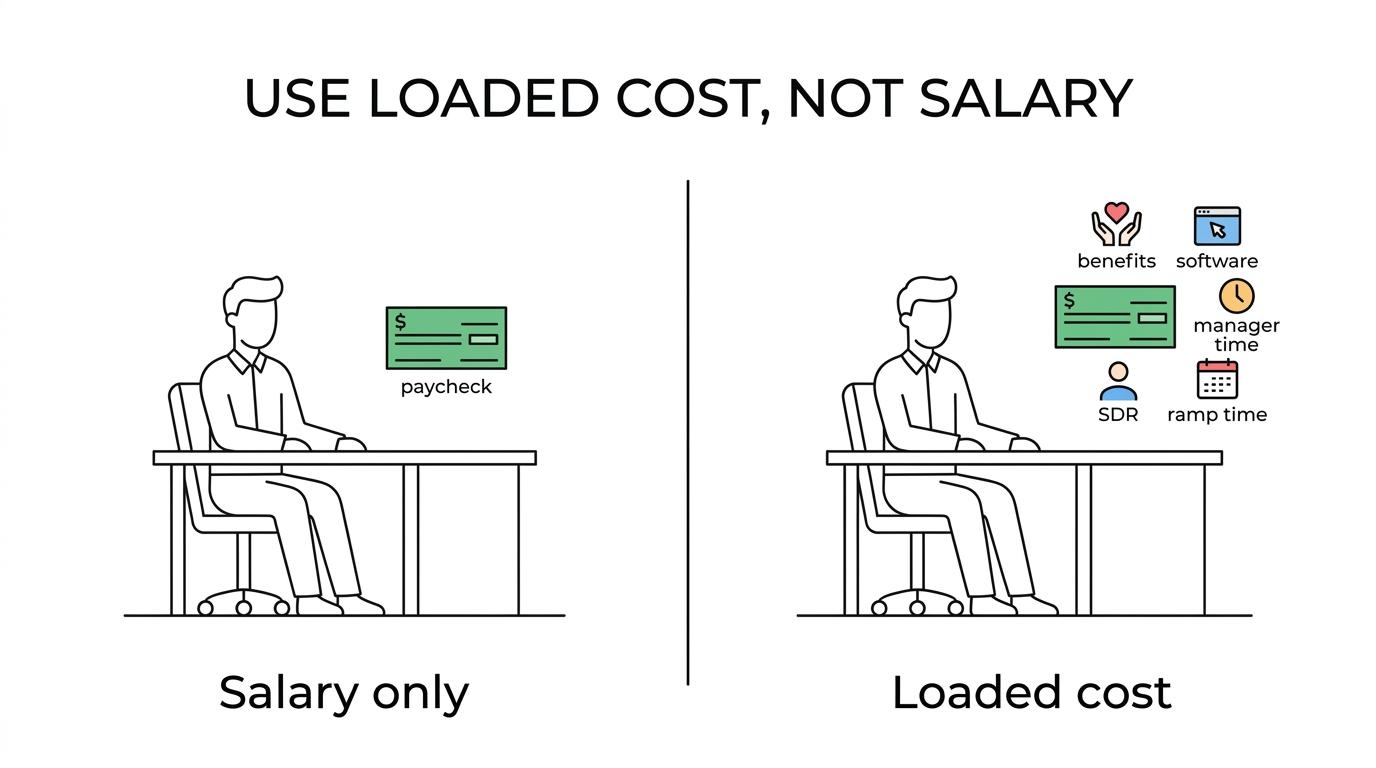
That does not mean agencies are always cheaper. It means you should compare against loaded cost, not salary alone.
What does your retainer pay for on a live outbound program?
This is where buyers either get comfortable or walk away.
A lot of sales outsourcing companies talk about meetings booked and skip the machinery needed to produce them. Good providers should be able to explain what your retainer funds before they talk about wins. That is more true in outbound than almost anywhere else, because infrastructure mistakes show up in your inbox before they show up in your report.
Thibault Garcia, founder of Reachly, puts it plainly: “Thirty thousand emails a month for one client means seventy-two domains and a hundred and eighty mailboxes. That is around nine hundred dollars in domains up front and six hundred and forty a month in mailboxes before anyone writes a word of copy.”
That is only the start. Garcia also notes that 45,000 leads a quarter can cost roughly a cent each all-in, plus about $500 to verify them. Then you still need the GTM engineer. In Reachly’s published unit economics, one GTM engineer who can write, choose angles, and build the system runs $2,500 to $5,000 per month. Agency margins on outbound sit in a 10 to 25 percent band.
That margin band is useful because it tells you what a retainer actually buys. It is not pure labor. It is labor, data, verification, domains, mailboxes, routing, reporting, and the reserve capacity to keep campaigns live when infrastructure goes bad.
A healthy retainer for outsourced business development usually covers work like this:
- List building and enrichment
- Domain and mailbox setup
- Warm-up and deliverability monitoring
- Copy and offer testing
- Reply management
- Appointment setting
- Reporting and iteration
If a vendor cannot tell you its view on authentication, warm-up, send caps, or list re-validation, you are not buying a sales function. You are buying messages pushed through software.
Which 12 tests should you use to rank sales outsourcing companies?
This is the part most “best of” pages skip. A provider should earn its place with numbers, operating detail, and fit.
Use this table as your shortlist filter.
[markdown] | Test | What good looks like | What to ask | | --- | --- | --- | | 1. Scope fit | The company can state whether it handles prospecting only, full outbound, qualification, nurturing, and booking | “What work stays with us, and what do you own?” | | 2. Proof tied to revenue | Case studies show SQLs, deals, pipeline, CAC, or contract value | “Show me outcomes beyond meetings booked.” | | 3. Clear ramp time | You get a dated expectation for setup, warm-up, and first meetings | “When do first qualified meetings usually land?” | | 4. Real infrastructure policy | SPF, DKIM, DMARC, custom tracking domain, 14 to 30 day warm-up, matching sender ESP to recipient ESP | “What is your domain setup process as of 2026?” | | 5. Dated sending limits | Google and Outlook caps are current, not recycled from 2023 | “What daily caps do you use per mailbox right now?” | | 6. Signal-based targeting | The provider uses buying signals, not static lists alone | “Which signals change who you contact?” | | 7. Offer work | The team helps shape the offer, not just the copy | “How do you fix a campaign with replies but no positives?” | | 8. Multichannel execution | Cold email, LinkedIn, cold calling work together | “How do the channels support each other by day?” | | 9. Data hygiene | Lists older than 3 months get re-validated and bounce rate target stays under 3% | “How often do you re-verify data?” | | 10. Reply handling | Replies are qualified, routed, and nurtured fast | “Who owns inbox triage every day?” | | 11. Reporting depth | You see inbox placement, reply rate, positive reply rate, meetings, and pipeline, not vanity metrics alone | “What does your weekly report include?” | | 12. Clear no-fit criteria | The vendor can tell you when not to buy | “Who should not work with you?” | [/markdown]A few of those deserve extra weight.
Proof should reach past activity. Reachly’s public case studies are useful because they show revenue, not just send volume. Primal produced 85+ SQLs in 6 months, 6 deals signed, 4.57x ROI, and a 35 percent CAC reduction. The Great Room closed a $250K contract, moved face-to-face meetings from 2 per quarter to 2 per month, and cut drop-off from 50 percent to 30 percent with zero added headcount.
Infrastructure should sound current. In 2026, that means daily caps around 15 for Google and 10 to 12 for Outlook, plus 30 days of Warm-up as the safer number because Google adds a yellow banner to mail from domains younger than 30 days. It also means matching sender ESP to recipient ESP and treating authentication as non-negotiable.
Offer work is where a lot of vendors fall short. Garcia’s view is blunt: “Every client gets the same question before we write a single email. If you had thirty seconds with your dream client, what would you offer them? If the answer takes longer than thirty seconds, we do not have an offer yet.”
That is the right test. A vendor that only rewrites copy is working too far downstream.
When should you skip outsourced business development?
Not every company should buy this.
The bad-fit cases are pretty consistent, and a serious provider should tell you this before you sign. Whole-function sales outsourcing is a bad fit when your market is too small, your offer is still muddy, or the economics do not support outside help.
The most common no-fit cases look like this:
- ACV under $5,000
- No product-market fit yet
- Founder still figuring out the pitch
- Tiny TAM with a short list of dream accounts
- Need is late-stage enterprise closing, not pipeline creation
Garcia says it clearly: “If your average contract value is under five thousand dollars, send the emails yourself for now. The math does not work for you and it does not work for us either, and I would rather say that on the first call.”
There is another caveat here. If you are selling a complex enterprise motion where discovery and closing depend on founder insight, do not outsource that part first. Outsource prospecting, outbound campaigns, reply handling, and appointment setting. Keep the conversations that shape the sales motion close to the product team.
How should you shortlist a sales outsourcing company in 14 days?
You do not need a 40-vendor bake-off. You need a short, hard process.
Start with five companies at most. Cut any provider that cannot show current deliverability policies, public proof, and a clear ramp timeline. Then ask each one to explain how it would run your first 30 days, what offer it would test first, and what it expects to learn before month two.
A good 14-day shortlist process usually looks like this:
- Day 1 to 3: collect case studies, scope docs, and reporting samples
- Day 4 to 6: run live calls focused on process, not pitch
- Day 7 to 10: compare ramp time, ownership boundaries, and proof
- Day 11 to 14: check references or public case studies, then choose
If you are comparing providers for full outbound ownership, ask to see how they handle the mechanics. Reachly’s process uses signal-based targeting in Clay, sending through Smartlead, LinkedIn execution in HeyReach, and verified data from tools like Apollo, Icypeas, ZeroBounce, and MillionVerifier. That matters because you are not just buying copy. You are buying a working system.
If you need a team that can own cold email, LinkedIn, cold calling, reply handling, and meeting booking, look at Reachly’s outbound lead generation services or managed SDR service. If you want to talk through the numbers against your in-house plan, you can book the meeting with Reachly there.
The short version: the best sales outsourcing companies are the ones that can show you loaded-cost math, current deliverability practices, revenue-backed proof, and a tight view of what they should and should not own. If a provider cannot explain the system behind the retainer, keep looking.
Key findings recap:
- Cost: year-one in-house SDR cost can land far above base salary, with Reachly publishing $132,400 versus $42,000 for a managed service model
- Selection: rank sales outsourcing companies on scope, proof, infrastructure, signals, and reporting, not meetings booked alone
- Fit: outsource pipeline creation first, keep late-stage closing in-house until the sales motion is stable