
Business development outsourcing is hiring an outside team to run the top of your B2B sales process: building the target account list, starting conversations over cold email, LinkedIn, and cold calling, handling the replies, and booking qualified meetings that your own reps then close. Running the same motion in-house at 30,000 emails a month costs about $3,500 to $6,100 a month in mailboxes, data, software, and one GTM hire, before recruiting time and a four-week mailbox warm-up. That is the bar any provider has to clear.
Key Findings
- Business development outsourcing hands targeting, outreach, reply handling, and meeting booking to an outside team. Discovery calls, proposals, and closing stay with your reps.
- Reachly's own line items put an in-house program sending 30,000 emails a month at roughly $3,500 to $6,100 a month, plus about $900 in domains. The Reachly managed retainer starts at $3,500 a month.
- First meetings land within 10 days on pre-warmed domains, or 5 to 6 weeks from kickoff on branded domains, because every new mailbox warms for four weeks.
- Outsourced programs fail most often on two points: a weak offer, and interested replies that wait hours for an answer.
- For The Great Room, meetings went from about 2 a quarter to about 2 a month, with $250K+ in contract value closed. Primal reached 85+ SQLs in 6 months at 4.57x ROI.
- Reachly rotates a mailbox out when reply rate drops under 0.5%, warm-up score under 95%, or bounce rate over 2%, and drops a message angle after 1,000 emails with no positive reply.
What does business development outsourcing include?
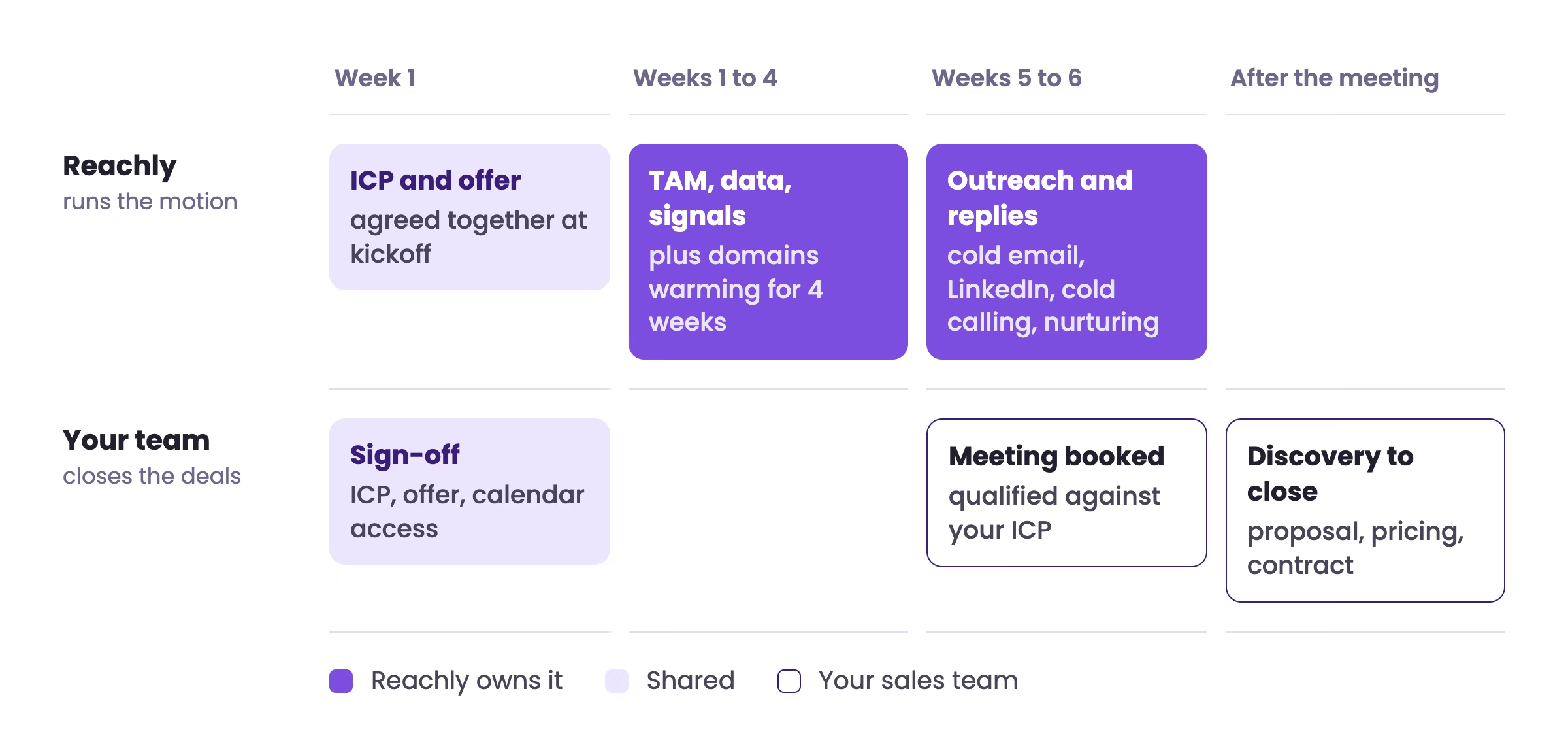
A full program covers every step between an empty list and a booked meeting. Reachly runs TAM building, data enrichment, signal scoring, copy, sending infrastructure, cold email, LinkedIn outreach, cold calling, lead nurturing, reply handling, and appointment setting. Your team signs off the ICP and the offer in week one, then takes every qualified meeting from there.
The diagram below shows who owns each stage and when it happens on new, branded domains. On pre-warmed domains the four-week warm-up drops out, and first meetings can land within 10 days.
What the provider runs
| Part of the system | What Reachly handles | What you get |
|---|---|---|
| Targeting | TAM mapping, ICP filtering, signal scoring in Clay, enrichment from 10+ data sources | A list built on fit and timing |
| Data quality | Email finding, double verification, re-validation of older lists, contact research | Fewer wasted sends and cleaner lists |
| Infrastructure | Secondary domains, 2 to 3 mailboxes per domain, authentication, four-week warm-up | Your main domain never sends cold email |
| Outreach | Cold email, LinkedIn, cold calling, copy and offer testing, sequencing | More chances to reach the right stakeholder |
| Reply handling | Inbox management, qualification, lead nurturing, appointment setting | Faster follow-up and fewer missed replies |
| Visibility | Live reporting dashboard and a shared inbox | A clear view of replies, meetings, and pipeline |
What your team keeps
Three things stay in-house. The offer needs your sign-off, because only your company can promise what the product delivers. Calendar access lets meetings land directly with the right rep. Every conversation after the first meeting, from discovery to contract, belongs to your sales team.
Reachly qualifies each meeting against the ICP criteria agreed in the TAM mapping, and 80 to 90% of meetings qualify when that mapping is done well. That agreement in week one is what keeps the calendar full of buyers rather than curious contacts.
How much does business development outsourcing cost compared with building it in-house?
The fair comparison is the monthly cost of running the same volume yourself. Thibault Garcia, Reachly's founder, broke down what it takes to send 30,000 cold emails a month for one client. The monthly column spreads the three-month data and verification purchases evenly.
| Line item | What you buy | Monthly cost |
|---|---|---|
| Domains | 72 domains, about $900 to buy | One-off |
| Mailboxes | 180 mailboxes | $640 |
| Lead data and enrichment | 45,000 leads over 3 months at about $0.01 each, $450 | $150 |
| Email verification | 45,000 credits, about $500 | About $167 |
| Sequencing software | Smartlead base plan or similar | $50 to $150 |
| People | 1 GTM engineer who can write and build, or a GTM operator plus a strategist | $2,500 to $5,000 |
| Total | Source: Thibault Garcia, Reachly campaign cost breakdown, 2026 | About $3,500 to $6,100, plus $900 up front |
The Reachly outbound lead generation retainer starts at $3,500 a month for the full stack across cold email, LinkedIn, and cold calling. The in-house numbers also leave out three costs that never show on an invoice: the months spent hiring, the four-week warm-up before the first send, and the SDR time needed to answer interested replies quickly.
Thibault's view on the in-house route: “you need to hire a GTM engineer, plus an SDR, plus pay for all of the tools yourself, and maybe even a copywriter depending on how good your GTM is. So it might be cheaper and faster to go down the agency route.”
For the numbers behind a pipeline target, such as how many emails, domains, and mailboxes it takes, see the Reachly pipeline generation guide.
How do outsourced teams improve pipeline velocity and quality?
They add meetings without adding headcount, and they filter who reaches your reps. Speed comes from infrastructure that is already warm and a team that tests offers every week. Quality comes from the list, because every contact is checked against the ICP before the first email goes out. Two Reachly clients show both effects.
Primal, a marketing agency in Thailand, chose outsourcing because building an internal SDR team would have taken months of hiring, training, and tooling before results became consistent.
Offer quality moves the numbers faster than anything else in the program. Thibault describes a Series A client that already had good lists, signals, and infrastructure, sending 20,000 to 30,000 emails a month. Rebuilding the offer around a lead magnet took them “from an average of 0.5 to 1% reply rates” to “a 1.6% reply rate.”
How does Reachly run signal-based outbound for clients?
Reachly builds targeting in Clay from company signals such as funding, hiring, leadership changes, tech stack changes, and headcount growth, then adds website visits, LinkedIn engagement, and intent scoring. The approach is laid out in the signal-based outbound playbook.
Some buying signals belong in the message and some only decide the timing. Funding is a good reason to reach out, but Reachly rarely mentions it in the email. Hiring activity is worth naming, because it shows the company is growing and gives the email a reason to exist.
Infrastructure that protects your domain
Your main domain never sends cold email. Reachly sets up secondary sending domains with 2 to 3 mailboxes each, SPF, DKIM, and DMARC, and a custom tracking domain. Every new mailbox warms for four weeks, sends 12 to 15 emails a day at most, and every list older than three months is re-validated before it is used.
The thresholds Reachly acts on
These rules trigger on their own, without waiting for a weekly review:
| Action | Trigger | Why |
|---|---|---|
| Pause or rotate a mailbox | Reply rate below 0.5%, Smartlead warm-up score below 95%, or bounce rate above 2%, whichever comes first | Reply rate moves earliest, so it is the one watched hardest |
| Retire a domain | Blacklisted on MXToolbox | A blacklisted domain is thrown away, never recovered |
| Stop testing an angle | 1,000 emails with no positive replies while overall reply rate stays healthy | Out-of-office replies confirm the inbox is reached, so the angle is the problem |
Reachly keeps roughly 30% of its sending infrastructure in reserve, warmed and ready, so a rotated mailbox can rest for one to two weeks and a blacklisted domain can be dropped without the client losing sending volume. That discipline is why bounce rate rarely becomes a problem, and why deliverability gets checked before copy is blamed.
The stack includes Clay, Smartlead, HeyReach, Apollo, LinkedIn Sales Navigator, ZeroBounce, MillionVerifier, ZapMail, Trigify, and RB2B, listed in full on the outbound tools page. Reachly is a Clay Solutions Partner and APAC's first Clay-certified agency.
Why does outsourced business development fail?
Most failures trace back to work the provider never owned. A vendor that only sources contacts, or only writes copy, hands your team a pile of replies with no qualification history attached. Before you sign, compare what each provider runs, for example in this list of 12 sales outsourcing companies.
A weak offer
Lists and infrastructure can be perfect and still produce 0.5% reply rates if the offer is weak. Reachly diagnoses a slow campaign in a fixed order: overall reply rate including out-of-office replies, to confirm the emails reach the inbox, then an inbox placement test, then bounce rate, then the replies themselves. A run of “no thanks” and “not interested” means delivery works and the offer is the problem.
Slow follow-up on interested replies
An interested reply that waits three hours for an answer is how a program leaks meetings. Reachly handles reply management and nurturing inside the same system that sourced and messaged the account, so the context travels with the lead, and Utkrusht Gupta on the sales operations team keeps campaign data and sequencing in order across accounts. On your side, someone has to take booked meetings within the day.
Questions to ask a provider before you sign
Copy these into your first call with any business development outsourcing provider. The answers tell you who owns the parts that usually break.
1. Who handles replies, and how fast does an interested reply get an answer?
2. Which domains send the email? Does my main domain ever send cold email?
3. How many emails does each mailbox send per day, and how long is warm-up?
4. What are your rules for pausing a mailbox or retiring a domain?
5. How do you decide that a message angle has failed?
6. What counts as a qualified meeting, and who agrees the criteria?
7. Which data sources and verification tools do you use?
8. What will I see each week: replies, meetings, or only send volume?
When should you build business development in-house instead?
It comes down to budget and timeline. In Thibault's words: “If the company has a lot of budget and they're willing to test things for a very long period of time before actually getting results, then I'll probably build this in-house.” Building in-house also makes more sense if you do not yet have a clear offer, or if nobody on your side can take and close meetings.
Outsourcing fits when these points sound familiar:
- You sell B2B and can name a clear ICP, offer, and sales outcome.
- You need more qualified meetings, but your internal team is busy closing or handling inbound.
- You want cold email, LinkedIn, and cold calling coordinated in one motion.
- You care about deliverability, domain protection, and data verification.
- You want feedback on your offer within a quarter, without managing day-to-day prospecting.
Reachly was founded in 2022 and has run 1,000+ campaigns for 80+ B2B clients, with about 4,500 positive replies last quarter. Founder Thibault Garcia spent eleven years across sales and growth marketing. For the wider plan that outsourcing slots into, see the outbound sales strategy guide.
Get qualified meetings without hiring an SDR team
Reachly runs signal-based outbound across cold email, LinkedIn, and cold calling from $3,500 a month, handles every reply, and books the meetings on your calendar.
Book the meeting with Reachly
Frequently asked questions
What are the risks of outsourcing business development?
The three that cost the most are lock-in, brand voice, and ownership. Check the contract length and notice period before you sign, ask who keeps the sending domains, mailboxes, and lead lists when the engagement ends, and read a week of sent emails yourself in month one. A provider that will not show you the sent copy or the raw replies is asking you to judge it on meetings alone, which leaves you blind for the first two months.
What are the four types of outsourcing?
General outsourcing guides split it by location: onshore, nearshore, offshore, and multisourcing across several vendors. For business development, splitting by scope is more useful. The four common models are a list or data provider, an outsourced SDR who works inside your tools, an appointment-setting service that books meetings from your own leads, and a fully managed outbound program that runs everything from TAM mapping to booked meeting.
What are the 7 stages of business development?
A common seven-stage version is research, prospecting, first outreach, qualification, the first meeting, proposal, and close. An outsourced team usually owns the first four and books the fifth. Proposal and close stay with your own reps, because pricing, scope, and contract terms need someone who can commit on behalf of the company.