


Discover the best sales development services for pipeline growth, from targeting and outreach to qualification, compliance, and meetings.
The best sales development services do 4 things well: build a real target list, work live buying signals, run cold email, LinkedIn, cold calling, and hand your closers qualified meetings. Reachly is one example of this category, a done-for-you outbound agency that ties sales development to pipeline and meeting quality rather than send volume.
TL;DR: Summary
- The best sales development services combine list building, signal-based targeting, multichannel outreach, reply handling, qualification, and meeting booking; Reachly fits this full-service model.
- Judge sales development services by pipeline outcomes, not activity counts. Published examples include about $250,000 in closed contract value for The Great Room and 85+ SQLs in 6 months for Primal.
- If a provider sells only leads, only sequences, or only appointments, you still own the hardest parts: targeting, compliance, qualification, and no-show reduction.
- Outsourced sales development is easiest to justify when your offer is clear, your deal size supports outbound, and your closers can convert qualified meetings.
- Any U.S.-facing commercial email program must follow the CAN-SPAM Act, including a clear opt-out explanation and a valid physical postal address.
That matters because outsourced SDR work is easy to buy and hard to judge. The gap between a vendor that books meetings and one that creates pipeline usually comes down to signal quality, compliance, and what happens after a prospect replies.
What are sales development services, exactly?
Sales development services are outsourced prospecting, qualification, and meeting-booking functions. In practice, they use tools like Clay and LinkedIn Sales Navigator to find the right accounts, start conversations, and pass qualified meetings to your closers.
A real sales development service does more than send messages. It maps your TAM, builds lists, validates contact data, sets up sending infrastructure, writes the outreach, handles replies, qualifies interest, and routes the meeting to sales.
That last part is where many buyers get burned. If a provider only hands you a spreadsheet or only promises "appointments," you still own the hard parts: message-market fit, inbox placement, qualification, and calendar conversion.
If you already know your ICP and your offer converts, sales development services add speed. If you do not, they act like a fast market test. You find out whether the issue is the list, the message, the timing, or the offer.
When do sales development services make financial sense?
Sales development services make sense when your deal size, TAM, and sales process can absorb outside demand. If your ICP is clear and your closers convert meetings, outbound usually tells you within the first 5 to 6 weeks whether the offer has legs.
The cleanest use case is a team that knows who it wants, knows what problem it solves, and needs more shots on goal without hiring and managing SDR headcount. Common mistake: buying outbound before you have an offer worth replying to. If nobody wants the thing behind the email, more volume just gets you faster rejection.
"Reachly says first meetings typically come within 10 days on pre-warmed domains, or 5 to 6 weeks from kickoff on branded domains when infrastructure, targeting, and outreach are built together."
Hiring is still an option, but it is not frictionless. The U.S. Bureau of Labor Statistics projects about 1.7 million openings per year on average across sales occupations from 2025 to 2035, mostly from replacement demand. That does not mean every opening is an SDR role, but it does show how much churn and backfill still shape sales hiring.
[markdown] | Source | Published | Fact | Why it matters | | --- | ---: | --- | --- | | U.S. Bureau of Labor Statistics | 2026 | About 1.7 million openings projected each year on average across sales occupations during 2025 to 2035 | Hiring and replacement demand stay high | | U.S. Bureau of Labor Statistics | 2026 | Median annual wage for sales occupations was $38,530 in May 2025 | Base wage alone does not capture the full cost of building a team | | U.S. Bureau of Labor Statistics | 2026 | Sales occupations projected to decline overall during 2025 to 2035 | Teams are pressured to get more output from tighter structures | [/markdown]What are the 12 sales development services that matter most for pipeline growth?
The best sales development services cover the whole motion, not one task. If a provider misses list quality, signal timing, reply handling, or meeting booking, you end up hiring the missing piece yourself.
- TAM mapping and ICP definition: who is in market, who is not, and why.
- Contact sourcing: account and lead data pulled from multiple providers, not one database.
- Signal-based targeting: hiring, leadership change, funding, tech stack change, traffic shifts.
- email validation, deduping, and re-validation for any list older than 3 months.
- Sending infrastructure: secondary domains, mailbox setup, SPF, DKIM, DMARC, custom tracking domain.
- Cold email copy: short, direct copy built to earn a reply, not force a meeting.
- LinkedIn outreach: connection flow, timing, short follow-ups, and profile-level targeting.
- Cold calling support: selective calling after digital touches, not blind dial volume.
- Reply management: inbox triage, routing, follow-up, and suppression of opt-outs.
- Qualification logic: rules for who gets passed to sales and who gets nurtured.
- Appointment setting: calendar coordination, reminders, and handoff notes for the AE.
- Reporting and iteration: reply rates, positive replies, bounce rates, show rates, and pipeline outcomes.
If you are comparing providers, use that list as a checklist. The more boxes you have to cover yourself, the less you are buying a service and the more you are buying labor fragments.
How do outsourced sales development services compare with hiring in-house SDRs?
Outsourced sales development trades headcount risk for managed execution. Reachly sits in this camp: an outside team handles list building, signal-based outreach, qualification, and booked meetings while your AEs stay focused on closing.
[markdown] | Factor | Outsourced service | In-house SDR hire | | --- | --- | --- | | Ramp time | Faster if infrastructure and playbook already exist | Slower if you still need domains, tooling, training, and QA | | Management load | Lower day to day burden on sales leadership | Higher, especially for coaching and list QA | | Infrastructure risk | Usually handled by provider on separate domains | Usually lands on your team | | Flexibility | Easier to pause, shift ICP, or test a new angle | Harder once headcount is in seat | | Process control | Less direct control over daily execution | More direct control, more operating burden | [/markdown]The misconception is that in-house always gives you more precision. It gives you more access, but not always better execution. If your manager does not have time to review lists, subject lines, inbox placement, and reply handling every week, the control is mostly theoretical.
How do full-service providers compare with list vendors or appointment setters?
Full-service sales development is different from buying a list or paying only for appointment setting. One model owns targeting, delivery, qualification, and follow-up. The other sells inputs and leaves conversion risk with you.
[markdown] | Model | What you get | What you still own | Best fit | | --- | --- | --- | --- | | Full-service sales development | List building, signals, outreach, reply handling, qualification, meetings | Offer quality, AE conversion, sales process | Teams that want a working outbound engine | | List vendor | Contacts and account data | Messaging, infrastructure, compliance, follow-up, qualification | Teams with strong SDR ops already in place | | Appointment setter | Meetings or handoffs | ICP, targeting, data quality, inbox placement, no-show control | Teams that already know their market and messaging | [/markdown]If you already have strong outbound operators, a list vendor can be enough. If you do not, buying data or meetings alone usually shifts the bottleneck instead of removing it.
How should a provider build your outbound system in the first 30 days?
A good provider should build the system in 3 stages during the first month: infrastructure, audience, and message. Tools like Smartlead, ZeroBounce, and LinkedIn Sales Navigator are useful, but the order matters more than the stack.
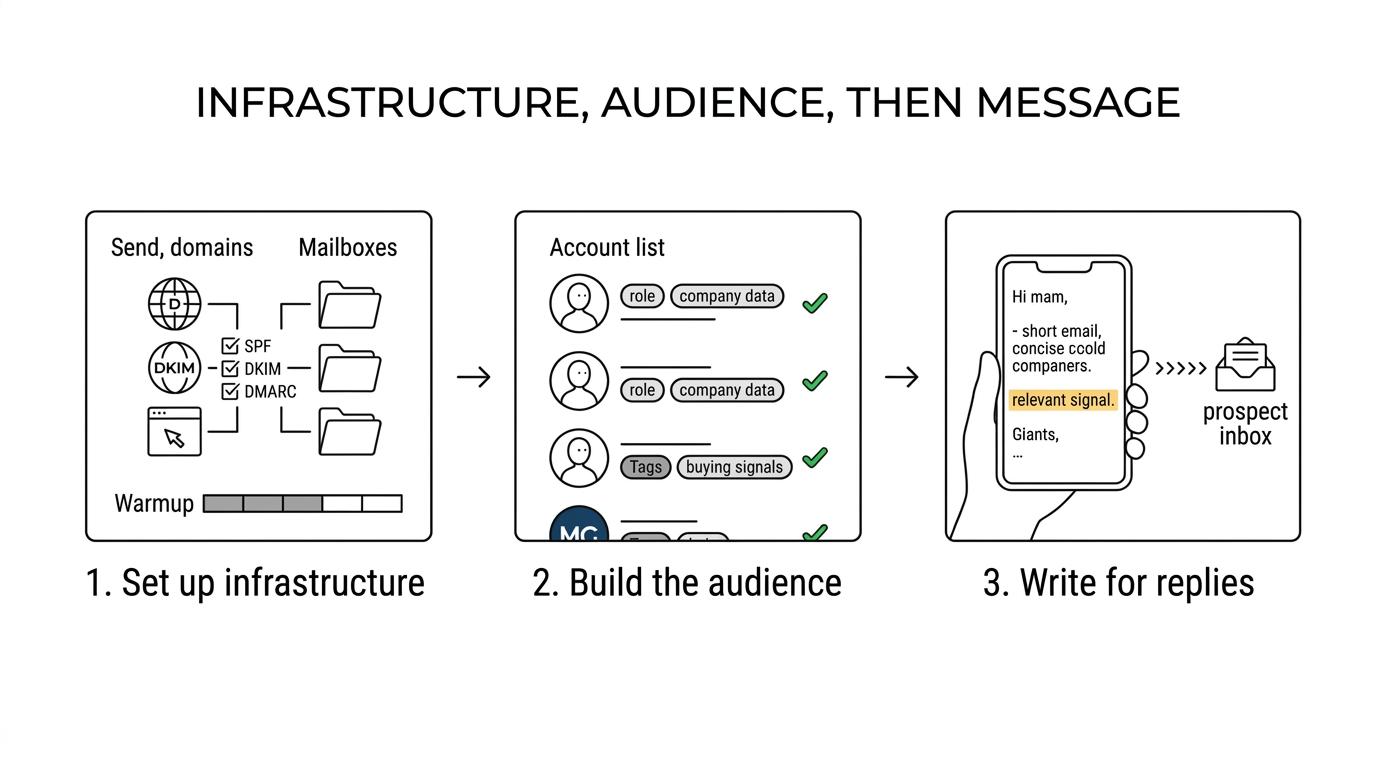
Step 1: Set up sending correctly. That means SPF, DKIM, DMARC, a custom tracking domain, and separate sending domains that protect your main domain reputation. Warmup takes four weeks, and Reachly never shortens it, because Google flags very new domains more aggressively.
Step 2: Build the audience with current data. Pull the account list, enrich it with role and company data, add signals, and re-validate anything older than 3 months. If the list is stale, the copy is not your first problem.
Step 3: Write for replies, not demos. Cold emails should fit on a phone screen, usually 70 to 80 words, with an opener tied to a signal or a clear explanation of why the prospect is on the list. A short sequence beats a long one that burns domain reputation.
The practical test is simple. If a provider promises booked meetings before the domains are warm and the list is verified, they are skipping steps that later show up as bounces, spam placement, or low-quality conversations.
What does a compliant sales development workflow look like for commercial email?
A compliant workflow includes legal basics and operational discipline. The FTC says the CAN-SPAM Act gives recipients the right to stop future commercial email, and each message must include a clear opt-out explanation plus a valid physical postal address.
Step 1: Build every template with compliance fields from day one. Do not patch them in later. Your footer, suppression logic, and sender identity should be part of the system before the first send.
Step 2: Treat opt-outs as a hard stop. Once a prospect says no or unsubscribes, suppress them across your outbound workflow. The law is the floor here, but your domain reputation is also on the line.
Step 3: Separate compliance from deliverability. You can meet CAN-SPAM requirements and still get buried in spam if your bounce rate is high or mailbox volume is reckless. Common misconception: legal compliance equals inbox placement. It does not.
[markdown] | Source | Published | Fact | Cost of getting it wrong | | --- | ---: | --- | --- | | Federal Trade Commission | 2023 | CAN-SPAM sets rules for commercial email and gives recipients the right to stop future marketing email | Complaints, suppression failures, wasted list spend | | Federal Trade Commission | 2023 | Marketing email must include a clear opt-out explanation and valid physical postal address | Noncompliant templates and process gaps | | Federal Trade Commission | 2023 | Each separate violating email can face penalties of up to $53,088 | Financial exposure plus reputation damage | [/markdown]How do the best services handle buying signals and timing?
The best timing comes from signals, not static job titles. Reachly uses a signal-based model built around events like hiring, funding, leadership change, traffic shifts, and tech stack changes, because timing usually beats broad personalization.
Not all signals are equal. Hiring is often more useful than funding because it shows a company is spending to solve a near-term problem. Funding gets overused. If a company raised money 6 weeks ago and every vendor is mentioning it, that fact has already lost most of its edge.
Signal shelf life is short, usually 2 to 4 weeks. If a VP Sales just joined, a new territory opened, or a company started hiring AEs, your outreach has context. If none of that changed, then you need a stronger offer because timing will not carry the message.
"Reachly’s The Great case study says internal outbound produced about 2 face-to-face meetings per quarter, while Reachly helped reach about that volume every month."
A useful pro tip here: do not dump every signal into the email. One relevant trigger is enough. AI can help write a short signal snippet, but you still need a human to sanity-check whether the reason to reach out actually matches the offer.
What benchmarks should you expect for meetings, reply rates, and list quality?
Expect quality benchmarks before volume benchmarks. A healthy outbound program targets bounce rate under 3%, deliverability above 97%, and positive reply rates in the 10% to 20% range, with 35% to 40% considered very good.
Reply rate matters more than open rate, and out-of-office replies tell you more about inbox placement than vanity metrics do. On LinkedIn, a 25% connection acceptance rate is a decent benchmark, and strong pilots can beat that. What you should really watch, though, is the chain from reply to qualified meeting to show rate.
Published case studies are useful because they move the conversation away from send counts. The Primal case study and The Great Room case study both show why pipeline quality matters more than raw activity.
"Reachly’s Primal case study reports 85+ SQLs in 6 months, 6 deals signed, and 35% lower CAC."
If you see high reply rates and weak pipeline, check the offer and qualification rules. If you see low reply rates across the board, check infrastructure, subject line, length, tone, and only then the broader sales message.
How do you choose the right sales development service for your team?
Choose the service that fixes your real bottleneck. If your team lacks targeting and infrastructure, buy a full outbound system. If your closers have pipeline but weak conversion, fix qualification and follow-up before you buy more meetings.
Step 1: Define what "good" means before you talk to vendors. That usually means target accounts, target personas, deal size, target geographies, and what counts as a qualified meeting.
Step 2: Ask for proof tied to business outcomes. Good proof is pipeline, SQLs, CAC movement, drop-off after qualification, or closed revenue. Activity screenshots are not enough.
Step 3: Inspect the operating model. Ask where the list comes from, how signals are scored, who handles replies, how opt-outs are managed, what the handoff to sales looks like, and how often the team changes copy or targeting.
If you want a reference point for what a managed motion should include, compare providers against a full outbound lead generation services scope and the appointment setting handoff requirements. The winning service is usually the one that owns the most failure points between "sent" and "booked the meeting."